
Your Factory Was Built to Last 25–30 Years. Is It Still Safe?
The Cikarang industrial corridor is one of Southeast Asia's largest manufacturing concentrations, home to over 5,000 companies across multiple industrial estates. Many of these factories were built during the rapid industrial expansion of the 1990s and early 2000s — meaning a significant portion of the building stock is now 25 to 30+ years old, approaching or exceeding the original structural design life.
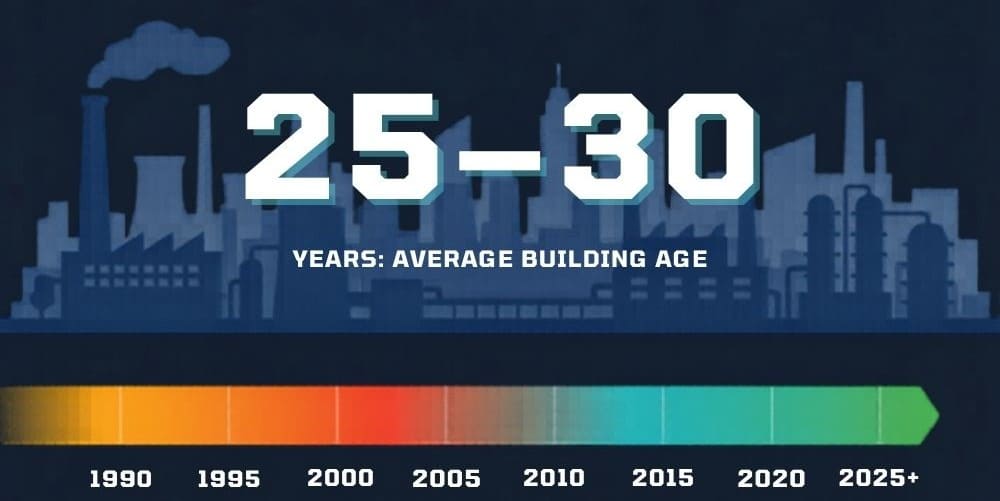
Age alone would warrant attention. But the situation is compounded by a critical regulatory change: Indonesia's seismic design code has been revised three times since most of these factories were built, and the current standard — SNI 1726:2019 — imposes significantly higher seismic demands on structures in the West Java corridor. A building that was fully code-compliant when constructed in 1996 is almost certainly no longer compliant today.
We provide structural assessment and strengthening services specifically designed for active industrial facilities in Cikarang and the surrounding Bekasi Timur corridor. Our approach uses certified MAPEI materials, is grounded in structural analysis rather than assumptions, and is scheduled around your production — because we understand that every hour of downtime is a measurable loss.
🏭 Why Cikarang Industrial Buildings Need Structural Attention Now
🏚️
Aging Building Stock
Most factories were built in the 1990s–2000s and are now 25–30+ years old — at or beyond their original design life
📐
Updated Seismic Code
SNI 1726:2019 raised design seismic loads for this region by 30–50% compared to the codes used when these buildings were designed
⚙️
Production Expansion
New machinery, mezzanine additions, and crane upgrades impose loads the original structure was never designed to carry
Cikarang Industrial Estates: Building Age Context
Understanding the age profile of buildings in each industrial estate is essential because age correlates directly with which design code was used at the time of construction, the current state of material degradation, and the gap between original capacity and current regulatory requirements.
📍 Cikarang Industrial Estates and Estimated Building Ages:
Jababeka Industrial Estate (Phase 1)
Operating since the early 1990s. First-generation buildings are now 30+ years old and were designed to seismic standards that are no longer in force.
East Jakarta Industrial Park (EJIP)
Operating since 1994. Early buildings are 28–30 years old. High concentration of Japanese and Korean multinational tenants with strict corporate audit standards.
MM2100 Industrial Town
Operating since 1997. First-phase buildings are 25–27 years old. Major concentration of automotive and electronics manufacturers.
Delta Silicon Industrial Park
Developed since the early 2000s. Buildings are 20–24 years old, entering the phase where structural evaluation becomes necessary.
Lippo Cikarang / Hyundai Industrial Complex
Mixed building ages spanning the 1990s to 2010s. First-generation structures have exceeded 25 years.
Jababeka Phase 2 & Cikarang Techno Park
More recent development with buildings 10–20 years old. Still relevant for evaluation when there are changes in loading or building function.
📌 Key context: The typical design life of an industrial building is 25–30 years. First-generation buildings in Jababeka, EJIP, and MM2100 have reached or exceeded this threshold and require comprehensive structural evaluation. See also our Factory Structural Strengthening page for general information on industrial building retrofit.
How Aging Degrades Industrial Building Structures
Concrete and reinforcing steel undergo predictable degradation over time — and the aggressive operating environments found inside factories accelerate these processes significantly. After 25–30 years of service, multiple degradation mechanisms are typically active simultaneously within the same structure.
⚠️ Degradation Mechanisms in Aging Factory Buildings:
Concrete Carbonation
Atmospheric CO₂ diffuses into the concrete pore structure and reacts with calcium hydroxide (Ca(OH)₂), forming calcium carbonate (CaCO₃). This reaction progressively lowers the pore solution pH from its initial ~12.5–13.5 down to below 9. When the carbonation front reaches the rebar depth and the pH drops below the depassivation threshold of approximately 11.5, the protective oxide layer on the reinforcement is destroyed, initiating corrosion. Carbonation depth progresses approximately per d = k√t (Tuutti, 1982), where k depends on concrete quality and exposure conditions. For typical industrial-grade concrete with w/c ratios of 0.5–0.6 and cover depths of 25–30 mm, the carbonation front commonly reaches rebar depth within 20–30 years.
Reinforcement Corrosion
Once depassivated — whether by carbonation or chloride ingress — the rebar corrodes, forming iron oxides that occupy 2–6 times the volume of the original steel (per ACI 222R). This expansion generates internal tensile stresses that crack and eventually spall the concrete cover, exposing more reinforcement and accelerating the cycle. In factory environments with high humidity, chemical exposure, or water infiltration, corrosion rates are substantially elevated. The consequences are direct: loss of rebar cross-sectional area reduces tensile capacity, spalling reduces the effective concrete section, and bond degradation between rebar and concrete compromises composite load transfer.
Fatigue from Cyclic Dynamic Loading
Industrial structures endure millions of load cycles over their service life — overhead cranes traversing runway beams, heavy forklifts on floor slabs, vibrating machinery on foundations. Over 25–30 years, this repeated loading accumulates micro-damage in both concrete and reinforcement, particularly at stress concentration points. Crane runway beams are the most vulnerable element: flexural fatigue cracking at midspan and diagonal shear cracking near supports are common findings in factories that have operated cranes continuously for two or more decades.
Concrete Strength Reduction
While concrete can gain strength beyond 28 days under ideal conditions, the operating environment of a factory is rarely ideal. Sustained exposure to chemical agents, thermal cycling (cold storage areas), moisture infiltration, and alkali-silica reaction in certain aggregates can all contribute to a net reduction in compressive strength over decades. Non-destructive testing (Schmidt hammer, UPV) and core drill testing on 25–30 year-old factory structures frequently reveal in-situ compressive strengths below the original design value.
⚠️ Important: Visual inspection alone is insufficient. Carbonation-induced corrosion begins inside the concrete and is only visible at the surface after significant section loss has already occurred. By the time you see rust stains or spalling, the rebar may have lost 10–30% of its original cross-section. Quantitative assessment — carbonation depth testing, half-cell potential mapping, rebar scanning, core drilling — is required for an accurate diagnosis.
The Seismic Code Gap: Why "Built to Code" No Longer Means "Safe"
This is the single most consequential structural issue facing aging factories in the Cikarang corridor — and the one most likely to surface during a headquarters compliance audit.
Indonesia's seismic design standard has undergone three major revisions since most Cikarang factories were originally designed:
📜 Evolution of Indonesia's Seismic Design Code:
SNI 1726:2002
The standard in effect when most Cikarang factories were designed. Based on older seismic hazard maps with lower design ground motions for this region.
SNI 1726:2012
First major revision. Updated seismic hazard maps based on probabilistic seismic hazard analysis (PSHA) with new fault and subduction zone data.
SNI 1726:2019
Currently in force. Further revised hazard maps with risk-targeted ground motions. Design seismic loads for the Cikarang/Bekasi corridor increased significantly from 2002 levels.
For the Cikarang and Bekasi Timur area, the spectral acceleration parameters in SNI 1726:2019 are substantially higher than those in the standards used when these factories were designed. This means that buildings which were fully compliant at the time of construction are now, by definition, under-designed for the seismic demands currently recognized for this region.
What this means for your factory's structural elements:
- Columns likely lack sufficient shear capacity and confinement reinforcement for the seismic demands in the current code. Column stirrup spacing in pre-2002 designs was typically much wider than what SNI 2847:2019 now requires for seismic detailing.
- Reinforcement detailing in older buildings commonly lacks seismic hooks on stirrups and ties — a critical deficiency for ductile behavior during an earthquake.
- Beam-column joints may not have been designed as a specific element at all, as older Indonesian practice often did not include explicit joint shear checks that are mandatory under current standards.
- Overall building ductility may be classified differently under current rules, potentially shifting from an assumed "special" or "intermediate" system to one that requires significantly higher design forces due to lower ductility classification.
🏢 For multinational factories subject to HQ compliance audits from Japan, Korea, or Europe: A proactive structural gap analysis against SNI 1726:2019 is the documentation your audit team will ask for. Many global companies now require periodic seismic vulnerability assessments of all production facilities worldwide. Having this assessment completed before the audit team arrives puts you in a far stronger position than responding to findings under a tight deadline.
Common Structural Problems We Address
Based on our experience with industrial buildings across the Cikarang corridor, the following are the most frequently encountered structural issues — along with the technical reasons behind them and the solutions we deploy.
1. Crane Runway Beam Damage
Overhead crane runway beams in automotive, metal fabrication, and heavy manufacturing plants — concentrated in MM2100 and EJIP — are among the most structurally demanding elements in any factory. After 20–30 years of cyclic dynamic loading, they are often the first elements to show distress.
What fails and why:
- Flexural cracking at midspan — cumulative fatigue damage from millions of crane travel cycles
- Diagonal shear cracking near supports — shear demand concentrated at beam ends, exacerbated by dynamic impact factors
- Increased deflection over time — stiffness degradation from progressive cracking, causing crane rail misalignment
- Capacity deficit after crane upgrade — many plants have upgraded from 5-ton to 10-ton cranes without evaluating the runway beam
Visible signs:
- Hairline to moderate cracks on the bottom face and sides of the beam
- Diagonal cracks propagating from the support region
- Visible deflection or crane rail misalignment
- Concrete spalling at bearing points
Our solutions:
- Flexural strengthening with Carbon Fiber (MAPEI MapeWrap C UNI-AX 300/600) — rapid application, adds negligible dead load, per ACI 440.2R-17 design guidelines
- Shear strengthening with U-wrap FRP or bonded steel plates
- Steel Plate Bonding with MAPEI Adesilex PG1 — adds both stiffness and flexural capacity, effective for deflection control under dynamic loads
- Structural crack injection with MAPEI Epojet LV to restore monolithic behavior of cracked sections
💡 Minimal disruption: Crane beam strengthening can be scheduled during weekends or night shifts when the crane is not operating. FRP application on a single beam typically takes 2–3 days. See details on our Carbon Fiber Strengthening and Steel Plate Bonding pages.
2. Column Damage from Forklift Impact and Corrosion
Column damage from forklift collisions is pervasive in warehouse and loading dock areas across Cikarang industrial estates. This is not a cosmetic issue — it is a structural capacity problem.
What fails and why:
- Concrete spalling at the column base — direct mechanical impact from forklifts removes the concrete cover
- Exposed and corroding reinforcement — once the cover is lost, rebar corrosion begins immediately in humid factory environments
- Reduced column axial and shear capacity — loss of concrete section and rebar area directly reduces the column's load-carrying ability
- Repeated damage at the same columns — traffic patterns concentrate impacts on specific columns
Visible signs:
- Broken concrete at column bases, often patched multiple times with non-structural material
- Rust staining on column surfaces
- Exposed rebar, sometimes with visible section loss
- Deformation or misalignment of column at the base
Our solutions:
- Concrete repair with MAPEI Mapefer 1K (anti-corrosion rebar coating) + MAPEI Mapegrout Thixotropic (structural repair mortar for vertical and overhead application)
- FRP Wrapping (MAPEI MapeWrap G UNI-AX 900 or MapeWrap C UNI-AX) — confinement after repair to restore and enhance axial and shear capacity
- Concrete Jacketing — for columns with severe damage or where major capacity increase is required
- Recommendation to install bollards or steel column guards to prevent recurrence
💡 Note: Repeated patch repairs without proper rebar treatment and structural assessment are not a solution — they mask ongoing capacity loss. A proper repair sequence (corrosion treatment → structural mortar → confinement wrapping) addresses the root cause. See our FRP Strengthening and Column Jacketing pages for method details.
3. Production Floor Slab Cracking and Settlement
Factory floor slabs in Cikarang receive relentless punishment — heavy forklifts running fixed routes, point loads from racking systems, and vibration from production machinery. Many buildings have also changed function from manufacturing to warehousing with high-bay racking, imposing concentrated loads the original slab was never designed for.
What fails and why:
- Pattern cracking from repeated forklift traffic — fatigue damage along fixed travel paths
- Slab settlement or differential settlement — Cikarang sits on alluvial soil with relatively high groundwater tables, making settlement a persistent concern for older buildings
- Overloaded slabs from new racking systems — e-commerce warehouse conversions often install multi-tier racking that exceeds original floor load capacity
- Construction joint deterioration — joints degrade under traffic and lose load transfer capability
Visible signs:
- Linear and map cracking on the floor surface
- Uneven floor levels, visible when water pools in certain areas
- Joint edges breaking down or curling
- Surface wear exposing aggregate
Our solutions:
- Slab flexural strengthening with Carbon Fiber (MAPEI MapeWrap C UNI-AX 300)
- Structural crack injection with MAPEI Epojet or MAPEI Epojet LV
- Surface repair with MAPEI Mapegrout Hi-Flow (self-leveling, high-early-strength)
- Void grouting with MAPEI Mapefill for areas with sub-slab voids from settlement
4. Seismic Retrofit — Column Confinement
Columns in factories built before SNI 1726:2012 almost universally lack adequate confinement reinforcement by current standards. Stirrup spacing is too wide, seismic hooks are absent, and the resulting column behavior under earthquake loading is non-ductile — meaning sudden, brittle failure rather than the controlled, energy-dissipating response that modern codes require.
What needs to change:
- Increase confinement to improve column ductility and prevent shear failure under seismic loading
- Enhance axial capacity where additional loads have been imposed
- Improve column performance at lap splice zones, which are often located at the base (worst location per current standards)
Our solutions:
- FRP Confinement (MAPEI MapeWrap G UNI-AX 900) — glass fiber wrapping provides continuous circumferential confinement, increasing both ductility and axial capacity without adding significant cross-sectional area. Design per ACI 440.2R-17.
- Carbon Fiber Wrapping (MAPEI MapeWrap C UNI-AX) — for columns requiring higher confinement pressure or combined shear strengthening
- Concrete Jacketing — for columns requiring the most significant capacity increase or where damage is too severe for FRP alone
- Full seismic evaluation — gap analysis between existing capacity and SNI 1726:2019 demand to prioritize which columns are most critical
💡 Scale advantage: For large-scale seismic retrofit programs involving dozens or hundreds of columns, GFRP wrapping (MAPEI MapeWrap G UNI-AX 900) offers the best balance of cost-effectiveness and structural performance. Work can be phased zone-by-zone to avoid disrupting the entire plant simultaneously.
5. Mezzanine Addition — Evaluating Existing Structure for New Loads
Adding a mezzanine is one of the most common modifications in Cikarang factories — it is the fastest way to gain usable floor area without expanding the building footprint. However, the original columns and foundations were not designed for the additional loads a mezzanine introduces.
What must be evaluated:
- Column axial capacity — does the existing column have reserve capacity for the additional dead load, live load, and seismic mass of the mezzanine?
- Foundation capacity — total load on the foundation increases; soil bearing capacity and settlement must be rechecked
- Beam capacity at mezzanine support points — if the mezzanine is supported on existing beams, those beams must be checked for the new concentrated loads
- Seismic behavior of the modified structure — adding mass at an elevated level changes the building's dynamic response and increases seismic demands on all elements below
Our solutions:
- FRP Confinement on columns — increase axial capacity to accommodate the additional mezzanine load
- Beam strengthening with Carbon Fiber or steel plates at mezzanine support locations
- Foundation assessment and strengthening if analysis indicates insufficient capacity
- Seismic re-evaluation of the overall structure with the mezzanine mass included
💡 Critical advice: Structural evaluation should be done before the mezzanine is built, not after problems appear. The cost of pre-construction assessment and preventive strengthening is a fraction of the cost of remediation after distress occurs in the existing structure.
6. Corrosion Damage in Aggressive Factory Environments
Factories with wet process areas, electroplating lines, chemical storage, or cold storage facilities experience structural degradation at rates far exceeding normal conditions. The combination of moisture, chemical exposure, and thermal cycling creates an environment that attacks both concrete and reinforcement aggressively.
What fails and why:
- Accelerated rebar corrosion — chemical exposure (acids, chlorides from plating processes) destroys the concrete's alkaline protection far faster than natural carbonation
- Thermal stress cracking — cold storage areas subject concrete to repeated thermal cycling, creating cracks that allow moisture and chemical ingress
- Roof steel corrosion — leaking roofs allow water to corrode roof trusses, purlins, and the ring beams they bear on
- Ring beam deterioration — water infiltration from the roof-wall interface causes persistent corrosion of the ring beam reinforcement
Our solutions:
- Concrete repair with MAPEI Mapefer 1K + MAPEI Mapegrout Thixotropic
- Structural strengthening of degraded elements with Carbon Fiber or FRP wrapping
- Protective coating with MAPEI Elastocolor for long-term barrier protection against chemical and moisture ingress
- Ring beam strengthening with Carbon Fiber or steel plates
Strengthening Methods We Deploy
Each method has specific technical advantages. The correct choice depends on the structural analysis results — not assumption or habit.
🧵 Carbon Fiber Reinforced Polymer (CFRP)
Material: MAPEI MapeWrap C UNI-AX 300/600
Typical applications in Cikarang: Crane runway beams, production floor slabs, ring beams, seismic retrofit
- Rapid application — 2–3 days per element
- Adds virtually zero dead load to the structure
- Immune to corrosion — ideal for aggressive factory environments
- Can be executed during weekends or night shifts
- Design per ACI 440.2R-17
🔷 Glass Fiber Reinforced Polymer (GFRP)
Material: MAPEI MapeWrap G UNI-AX 900
Typical applications in Cikarang: Column confinement, large-scale seismic retrofit programs
- More cost-effective than carbon fiber per unit area
- Excellent confinement effect for circular and rectangular columns
- Significantly improves ductility under seismic loading
- Ideal for programs involving large numbers of columns
🔩 Steel Plate Bonding
Material: Steel plates + MAPEI Adesilex PG1
Typical applications in Cikarang: Crane runway beams, main girders
- Adds stiffness — effective for deflection control under dynamic crane loads
- Familiar technology for plant maintenance teams
- Well-suited for beams under cyclic loading
- Lower material cost than FRP composites
🧱 Concrete Jacketing
Material: Reinforced concrete + shear connectors
Typical applications in Cikarang: Severely damaged columns, major capacity upgrades
- Highest achievable capacity increase of any method
- Most economical cost per unit of strength added
- Excellent fire resistance
- Simultaneously repairs and strengthens the element
MAPEI Repair and Strengthening Product Reference
For concrete damage including spalling, rebar corrosion, honeycombing, and structural cracking, we use repair and strengthening products from MAPEI — tested and proven for industrial environments.
| MAPEI Product | Function | Application in Cikarang Factories |
|---|---|---|
| Mapefer 1K | Anti-corrosion rebar coating | Protection of exposed rebar in humid areas, wet process zones, chemical storage |
| Mapegrout Thixotropic | Structural repair mortar (overhead/vertical) | Spalling repair on columns, beams, forklift-damaged areas |
| Mapegrout Hi-Flow | Flowable structural repair mortar | Production floor repair, machine foundation rehabilitation |
| Mapegrout Fast Set | Rapid-setting repair mortar | Emergency repairs in areas with zero downtime tolerance (30-minute setting) |
| Epojet / Epojet LV | Structural crack injection resin | Crack injection in crane beams, columns, machine foundations, floor slabs |
| Mapefill | Non-shrink cementitious grout | Base plate re-grouting, machine foundation grouting, anchor bolt grouting |
| MapeWrap 12 | Protective coating for FRP systems | UV and environmental protection for installed FRP strengthening systems |
💡 Need materials only? If your in-house maintenance team handles minor concrete repairs, we also supply MAPEI products for direct purchase. Material selection consultation is free of charge. Visit our MAPEI Applicator & Distributor page for details.
Industrial Estates We Serve
🏭 Jababeka
Jababeka Industrial Estate Phase 1 and Phase 2, Jababeka Science & Techno Park, President University area
🏭 EJIP
East Jakarta Industrial Park — high concentration of Japanese and Korean multinational manufacturers
🏭 MM2100
MM2100 Industrial Town — the largest automotive and electronics manufacturing hub in the Cikarang corridor
🏭 Delta Silicon
Delta Silicon Industrial Park and Delta Silicon 5 in Lippo Cikarang
🏭 Lippo Cikarang
Lippo Cikarang Industrial Area and Hyundai Industrial Complex
🏭 Surrounding Areas
GIIC Deltamas, Bekasi Fajar, and other industrial zones along the Cikarang–Bekasi Timur corridor
📍 Our location: Based in Bekasi with direct access to all industrial estates in the Cikarang corridor. We also serve industrial zones in Karawang, Tangerang, Bogor, and other areas. See our Factory Structural Strengthening page for services in other industrial zones.
Our Process: How We Work in Active Production Environments
Structural strengthening inside an operating factory requires a fundamentally different approach from standard construction. We design every step of the process to minimize disruption to your production schedule — because we understand that unplanned downtime is not an option.
🔄 Project Workflow:
- 1
Initial Consultation & Site Visit
We discuss your concerns, visit your facility, and conduct a preliminary visual assessment of the structural condition. This initial visit is free of charge and carries no obligation.
- 2
Structural Investigation & Testing
Visual damage mapping, concrete quality testing (Schmidt hammer rebound, ultrasonic pulse velocity), reinforcement scanning (electromagnetic rebar scanner/covermeter), carbonation depth testing (phenolphthalein indicator), and core drilling where required. All testing is conducted with minimal disruption to operations.
- 3
Structural Analysis & Strengthening Design
Evaluation of existing capacity versus current demands (including seismic loads per SNI 1726:2019), selection of the most appropriate strengthening method, detailed design calculations, and technical specifications. FRP design follows ACI 440.2R-17 guidelines.
- 4
Proposal & Schedule Coordination
Detailed proposal with clear scope, methodology, timeline, and cost. The work schedule is coordinated with your production calendar — weekends, night shifts, national holidays, or annual shutdown periods.
- 5
Execution
Performed by trained crews operating under industrial safety standards — safety induction, full PPE, permit to work (hot work, confined space, working at height as applicable), JSA, daily toolbox meetings. MAPEI materials with quality control at every stage.
- 6
Quality Control & Technical Documentation
Post-work inspection, before-and-after photographic documentation, and a comprehensive technical report. Reports are available in English for multinational clients and are suitable for corporate audit documentation.
Why Choose Us for Your Factory in Cikarang
📐 Analysis-Driven, Not Assumption-Driven
Every strengthening recommendation is based on investigation and structural analysis. We do not propose solutions before understanding the problem thoroughly — because a correct diagnosis is half the solution.
🏭 Production-First Scheduling
Your factory cannot stop. Our methods and work schedules are designed to minimize production impact — including execution during weekends, night shifts, holidays, or annual plant shutdowns.
🧪 MAPEI-Certified Materials
We use products from MAPEI (Italy) that are certified for structural applications in industrial environments. Corrosion-resistant, chemical-resistant, and engineered for long service life.
📋 Industrial Safety (K3) Compliance
Our teams understand and comply with factory safety protocols — safety induction, full PPE, permit to work, JSA, toolbox meetings, and MSDS documentation for all materials used.
🕐 Fast Mobilization from Bekasi
Based in Bekasi with direct access to all Cikarang industrial estates. Fast response time for consultations, site visits, and crew mobilization.
📄 English-Language Technical Documentation
All structural reports, proposals, and project documentation can be provided in English — essential for multinational companies reporting to headquarters in Japan, Korea, Europe, or the United States.
Types of Projects We Handle in Cikarang
The following represents the scope of structural strengthening work we perform for factories and industrial facilities across the Cikarang corridor:
- Seismic retrofit — evaluation and strengthening of columns, beams, and joints to comply with SNI 1726:2019
- Crane runway beam strengthening — for fatigue damage or crane capacity upgrades
- Column repair and strengthening — forklift impact damage, corrosion, or increased loading
- Production floor slab reinforcement — cracking, settlement, or capacity increase for new racking systems
- Pre-mezzanine structural evaluation and strengthening — ensuring the existing structure can safely carry the additional loads
- Machine foundation assessment — for new equipment installation on existing foundations
- Corrosion damage repair — structural rehabilitation in wet process, chemical storage, and cold storage areas
- Machine foundation re-grouting — using MAPEI Mapefill for foundations with excessive vibration or settlement
- Ring beam repair and strengthening — addressing water infiltration damage from the roof-wall interface
Frequently Asked Questions
Our factory was built in the late 1990s and looks fine visually. Does it really need evaluation?
Yes. Structural degradation is not always visible to the naked eye. Concrete carbonation and early-stage reinforcement corrosion occur inside the structural element and only become visible on the surface after significant damage has already occurred — typically when corrosion products have expanded enough to crack and spall the concrete cover, by which point rebar section loss may already be substantial.
Beyond material degradation, there is the seismic code issue: a factory designed before SNI 1726:2012 was built to seismic loads that are significantly lower than those recognized for the Cikarang area under the current SNI 1726:2019. The building may look fine, but its seismic capacity is almost certainly insufficient by today's standards.
Periodic structural assessment for buildings over 20 years old is a preventive measure that is far more economical than emergency repair after failure.
Does the factory have to stop production during strengthening work?
No. Most of the strengthening methods we use can be executed without halting production:
- FRP / Carbon Fiber: Minimal disruption — can be applied while production continues in adjacent areas
- Steel Plate Bonding: Relatively fast installation with limited area closure
- Concrete Jacketing: Requires a work zone around the column, but does not require shutting down the entire plant
- Crane Beam Strengthening: Scheduled when the crane is not operating (weekends or night shifts)
We always coordinate with your production and maintenance teams to develop a work schedule that minimizes impact on output.
What is the typical duration of strengthening work?
It varies with scope. The following are reference timeframes:
- FRP wrapping on 1 column: 1–2 days
- CFRP strengthening of 1 crane beam: 2–3 days
- Repair of a forklift-damaged column (repair + FRP): 3–5 days
- Concrete jacketing of 1 column: 2–3 weeks (including curing)
- Large-scale seismic retrofit program (many elements): Phased over weeks or months, sequenced zone-by-zone to avoid disrupting the entire plant
For large projects, we recommend a phased approach by production zone, so that each area experiences only a brief, planned interruption.
Can work be done during weekends or annual plant shutdown?
Absolutely. We are fully flexible with scheduling:
- Weekends (Saturday–Sunday)
- Night shifts (after the last production shift)
- National holidays
- Annual shutdown periods (typically year-end or Eid al-Fitr)
For FRP wrapping in particular, off-production-hours execution is often more efficient because access to the work area is unobstructed.
Our principal/HQ in Japan, Korea, or Europe is conducting a building safety audit. Can you help us prepare?
Yes. Many multinational companies require periodic structural safety assessments of all production facilities globally. We can support you with:
- Structural evaluation against the current seismic code SNI 1726:2019
- Gap analysis identifying specific elements that do not meet current standards, with quantified capacity deficits
- English-language technical reports formatted for corporate audit documentation
- Remediation recommendations and execution if deficiencies are identified
A proactive assessment completed before the audit team arrives is far more effective than scrambling to respond to audit findings under a tight deadline.
We are about to sign a lease on a second-hand factory in Cikarang. Should we do a structural assessment first?
Strongly recommended. When you take over a second-hand factory, you inherit the entire structural condition from the previous tenant — including problems that may not be visible. A structural assessment should be part of your due diligence before or immediately after the lease is signed.
What should be evaluated:
- General condition of primary structural elements (columns, beams, slabs, foundations)
- History of modifications made by the previous tenant (mezzanines, crane upgrades, wall openings)
- Whether the structure's capacity matches your planned operational requirements
- Compliance with the current seismic code (SNI 1726:2019)
We provide a free preliminary assessment to give you an honest initial picture of the building's structural condition before you commit.
Do you provide English-language structural reports?
Yes. All structural investigation reports, analysis summaries, strengthening design documentation, and project completion reports can be prepared in English. This is standard practice for our multinational clients who need to submit documentation to regional or global headquarters. Reports include technical methodology, test results, structural analysis summary, before-and-after photographs, and material certifications.
What is the typical cost for factory structural strengthening in Cikarang?
Cost varies significantly depending on several factors:
- Type and severity of damage or strengthening required
- Method selected (FRP, steel plates, concrete jacketing, or a combination)
- Number of structural elements to be addressed
- Site access conditions and working environment
- Schedule (standard hours vs. weekend/night premium)
Contact us for a free site visit and we will prepare a detailed quotation based on the actual conditions at your facility.
Can we purchase MAPEI materials directly for in-house repairs?
Yes. In addition to our strengthening services, we distribute MAPEI products. If your maintenance team handles minor concrete repairs internally, you can purchase materials such as:
- Mapegrout Thixotropic / Hi-Flow (structural repair mortars)
- Mapefer 1K (anti-corrosion rebar coating)
- Epojet / Epojet LV (crack injection resins)
- Mapefill (non-shrink grout)
- And other MAPEI products
Material selection consultation is free of charge. Full details on our MAPEI Applicator & Distributor page.
📞 Free Structural Assessment for Factories in Cikarang Industrial Estates
Is your factory building more than 20 years old? Are you planning a mezzanine addition, crane upgrade, or new equipment installation? Have you noticed cracking, spalling, or other signs of deterioration on columns, beams, or floor slabs?
We provide a free, no-obligation preliminary structural assessment for factories in Cikarang industrial estates — Jababeka, EJIP, MM2100, Delta Silicon, Lippo Cikarang, and surrounding areas.
Contact us to schedule a visit and discuss the structural condition of your building.