Structural Assessment for Heavy Industrial Facilities in Morowali
Morowali has become one of Indonesia's most important heavy industrial corridors, especially for nickel downstream processing, stainless steel, carbon steel, battery material supply chains, power generation, port logistics, and industrial support facilities. The operating environment is very different from a typical light manufacturing estate: structures are exposed to large equipment loads, heat, vibration, aggressive process conditions, and continuous production demands.
For plant managers, engineering teams, reliability teams, procurement departments, HSE teams, EPC contractors, and owner representatives, structural issues in Morowali are rarely just "building repair" items. They often affect asset integrity, shutdown planning, equipment reliability, production continuity, and CAPEX decisions.
Struktura provides structural assessment, repair, and strengthening services for heavy industrial facilities in Morowali. Our work is intended to help project teams make data-based technical decisions before carrying out repair work, changing equipment, increasing operating loads, upgrading crane capacity, or modifying existing structures.
Why Heavy Industrial Facilities in Morowali Need Structural Assessment
🏗️
High Operational Loads
Furnaces, cranes, conveyors, tanks, crushers, rotating equipment, pipe racks, and heavy vehicles impose static and dynamic loads that must be verified against actual structural capacity.
🔥
Aggressive Environment
Heat, vibration, process dust, humidity, chemicals, water ingress, and corrosion can accelerate degradation in concrete, steel members, anchor bolts, and protective coatings.
📈
Capacity Expansion
New production lines, heavier equipment, added platforms, crane upgrades, and utility changes require structural review before installation or procurement commitment.
Structural Risk Profile in Morowali Industrial Facilities
The structural risk profile in Morowali is closer to heavy process industry than standard warehousing or light manufacturing. Many facilities operate around high-temperature processes, bulk material handling, heavy rotating equipment, crane operations, and logistics traffic that cannot be stopped for long periods.
Structural Areas That Usually Need Close Attention:
Furnace and high-temperature process areas
Concrete and steel elements near heat sources may experience thermal stress, cracking, deformation, coating deterioration, or accelerated material degradation.
Machine foundations and equipment pedestals
Heavy equipment, pumps, blowers, crushers, conveyor drives, and rotating machinery can lead to foundation cracking, loose anchor bolts, damaged grout, or alignment issues.
Crane runway beams and material handling structures
Overhead cranes, hoists, monorails, and handling systems create repeated dynamic loads that must be reviewed when capacity is upgraded or visible distress appears.
Pipe racks, platforms, and steel structures
Corrosion, weak connections, inadequate bracing, and added utility lines can change the load path and reduce the available structural margin.
Industrial slabs and logistics routes
Forklifts, loaders, trucks, bulk materials, and heavy storage can cause slab cracking, joint failure, local settlement, or uneven floor surfaces.
Support buildings and utility facilities
Workshops, warehouses, power houses, control rooms, and operational buildings still need review when their function, load, or damage condition changes.
Important context: This page discusses structural needs for industrial facilities in Morowali and surrounding areas. References to IMIP are used only as regional industrial context, not as a claim of affiliation, contract, endorsement, or official relationship with the estate operator.
Facility Types We Support
Struktura supports structural evaluation and strengthening for industrial assets that carry heavy loads, operate near process areas, or require modification as production capacity grows.
Nickel smelters and processing plants
Structural assessment, concrete repair, equipment foundation review, and strengthening for elements affected by heat, vibration, corrosion, or heavy equipment loads.
Battery material and downstream processing facilities
Capacity review for existing structures before production expansion, equipment replacement, additional utility lines, or process-area modification.
Maintenance workshops and fabrication areas
Assessment of columns, crane runway beams, machine pedestals, steel frames, and slabs used for heavy equipment maintenance or fabrication activity.
Power plant and utility structures
Review of equipment foundations, baseplates, anchor bolts, pipe racks, platforms, and concrete or steel elements exposed to heat or vibration.
Logistics, jetty support, and storage areas
Evaluation of corrosion, vehicle loads, settlement, slab performance, and structures supporting industrial logistics and material handling.
Control rooms and operational buildings
Condition review for existing buildings with cracking, dampness, functional changes, additional loads, or retrofit needs.
Common Issues That Trigger Structural Review
In heavy industrial facilities, damage is often caused by several mechanisms at the same time: actual operating loads exceeding the original design assumptions, repeated vibration, corrosion, settlement, layout changes, and aggressive process exposure.
| Site Condition | Structural Risk | Recommended Direction |
|---|---|---|
| Cracks in columns, beams, slabs, or crane beams | Element capacity needs verification, especially if cracks are active, widening, or located in critical production areas | Visual inspection, crack mapping, material testing, capacity analysis, then repair or strengthening |
| Spalling concrete or exposed reinforcement | Reinforcement corrosion can reduce steel area and damage concrete cover | Concrete repair, rebar treatment, corrosion protection, and strengthening if capacity has been reduced |
| Cracked machine foundation or loose baseplate | Dynamic loads may damage grout, anchors, pedestal concrete, and equipment alignment | Machine foundation assessment, re-grouting, pedestal repair, anchor review, and vibration evaluation |
| Damaged slabs in forklift or heavy-vehicle routes | Slab failure can affect material handling, safety, and production continuity | Slab thickness and quality review, joint repair, overlay, local strengthening, or replacement strategy |
| Crane runway beam capacity concern | Crane upgrade or fatigue from repeated loads can cause deflection, cracking, or connection distress | Crane load review, runway beam assessment, strengthening of beams, columns, brackets, or connections |
| Corroded or deformed steel structure | Section loss and weak connections can reduce load-carrying capacity | Corrosion inspection, local replacement, plate reinforcement, bracing improvement, and protective coating |
| New equipment, platform, or pipe rack load | Added loads may exceed the capacity of the existing structure | Drawing review, load modelling, capacity check, and strengthening design before installation |
Scope of Services
We approach industrial structural projects in stages: understand the site problem, collect enough data, evaluate structural capacity, then select a repair or strengthening method that fits the technical risk and operating constraints.
Typical Scope:
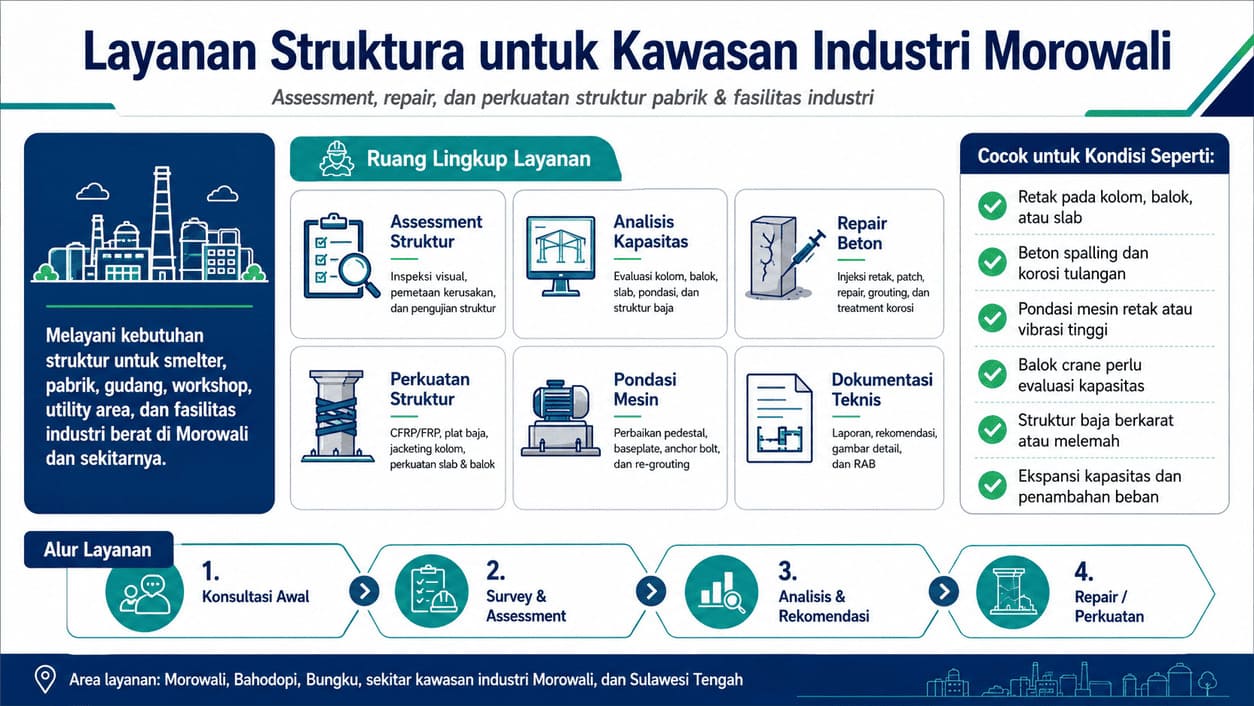
Structural Condition Assessment
Visual inspection, damage mapping, review of structural drawings, review of operational loads, site documentation, and identification of critical elements.
Testing and Data Collection
Hammer test, UPV, core drill, rebar scan, carbonation or chloride testing, and other investigation methods selected according to project risk.
Capacity Evaluation
Engineering review of columns, beams, slabs, foundations, pedestals, crane runway beams, pipe racks, platforms, and steel structures under current and planned loads.
Concrete Repair and Crack Injection
Epoxy injection, patch repair, spalling repair, grouting, rebar corrosion treatment, and restoration of concrete damaged by industrial exposure.
Structural Strengthening
CFRP, FRP wrapping, steel plate reinforcement, column jacketing, slab strengthening, crane runway beam strengthening, and local retrofit based on analysis.
Technical Deliverables
Assessment report, repair recommendations, strengthening details, BOQ/RAB, method statement input, and documentation for engineering, procurement, HSE, audit, and maintenance planning.
Strengthening Methods for Active Industrial Plants
Facilities in Morowali usually operate under tight production pressure. The strengthening method must therefore consider access, shutdown windows, permit to work, HSE requirements, material durability, and the risk of disrupting production.
Carbon Fiber / CFRP
Carbon fiber can be suitable for flexural or shear strengthening of selected concrete beams and slabs because it is lightweight, fast to install, and does not significantly increase member dimensions. In hot process areas, the service temperature and protection requirements must be reviewed before specifying CFRP.
FRP Wrapping
FRP wrapping can be used for column confinement, ductility improvement, or local strengthening where access is limited and the owner wants to avoid major dimensional enlargement of existing columns.
Steel Plate Reinforcement
Steel plate reinforcement is relevant for beams, connections, crane-related structures, or local capacity upgrades. In corrosive industrial environments, coating details and long-term corrosion protection must be included in the method.
Column Jacketing
Column jacketing is used for more severe damage or significant capacity increase. It is more intrusive than FRP, but it can be the appropriate method when the structural demand is high or the existing member condition is poor.
Epoxy Injection, Concrete Repair, and Re-Grouting
Epoxy injection helps restore monolithic behavior in selected structural cracks. Grouting and re-grouting are used for baseplates, machine foundations, voids, and areas requiring stable load transfer. For heavy industrial facilities, re-grouting machine foundations is often part of restoring equipment performance and reducing operational risk.
Why Not Proceed With Repair Without Assessment?
Fast repair can be tempting when cracks, spalling, or damaged slabs are visible. For an active plant, however, repair without assessment can hide the symptom while leaving the root cause unresolved.
Cracks in a slab may come from shrinkage, settlement, forklift traffic, heavy racking, weak concrete, or a load change. Cracks in a crane runway beam may be related to dynamic load, fatigue, reinforcement detail, misalignment, or a crane capacity upgrade. Spalling may be driven by rebar corrosion, carbonation, chemical exposure, water ingress, or impact damage.
Assessment helps the project team determine:
- whether damage is local or indicates a structural capacity issue
- whether an area can remain in service while waiting for repair
- what testing is needed so decisions are not based on assumptions
- which repair or strengthening method is technically and commercially reasonable
- how work should be sequenced to reduce production downtime
Procurement and Engineering Support
For multinational companies, the technical decision is only one part of the process. The work also needs to be clear enough for procurement, HSE review, vendor evaluation, technical clarification, and management approval.
How We Support Internal Project Teams:
Clear Scope of Work
We help define the affected areas, structural elements, required investigation, technical deliverables, and work boundaries before commercial comparison.
Procurement-Ready Documentation
Reports, BOQ/RAB inputs, method recommendations, material selection, and technical notes can support internal approval and vendor evaluation.
HSE and Site Coordination
Work planning can be aligned with permit to work, JSA, LOTO, working-at-height controls, hot work restrictions, and site induction requirements.
Shutdown and Access Planning
Recommendations consider limited shutdown windows, operational access, equipment isolation, material logistics, and staged implementation.
Project Workflow
Typical Assessment and Strengthening Process:
Initial consultation
The plant or project team shares photos, location, structure type, equipment information, operating constraints, and the reason for review.
Document and operational data review
We review drawings, layouts, load data, crane capacity, equipment specifications, previous modifications, and available maintenance history.
Site survey and condition mapping
Inspection focuses on critical elements, crack patterns, corrosion, settlement, slab condition, machine foundations, steel connections, and access constraints.
Testing if required
Hammer test, UPV, core drill, rebar scan, carbonation or chloride test, and other investigation methods are selected based on risk and data needs.
Engineering analysis and recommendation
Field data is reviewed against actual and planned loads to define safe areas, restricted areas, and elements requiring repair or strengthening.
Method, budget, and implementation planning
Execution is planned around access, shutdown window, permit to work, risk priority, crew mobilization, material availability, and plant operations.
Service Area and Mobilization
We support consultation and project mobilization for industrial facilities in Morowali, Bahodopi, Bungku, Morowali industrial areas, areas around IMIP, and other parts of Central Sulawesi, subject to project scope, site access, HSE requirements, and technical needs.
National mobilization: Struktura is based in Bekasi and serves structural strengthening projects across Indonesia. For Morowali projects, scope, duration, manpower, testing equipment, materials, site access, and mobilization schedule are reviewed from the proposal stage.
FAQ: Structural Assessment for Morowali Facilities
Do you serve projects in Morowali and Central Sulawesi?
Yes. We serve projects nationally, including industrial facilities in Sulawesi. For Morowali, mobilization requirements are calculated based on scope, schedule, site access, testing equipment, manpower, material logistics, and work duration.
Can assessment be performed while the plant remains operational?
In many cases, yes. Visual inspection, damage mapping, rebar scanning, hammer test, and UPV can often be scheduled by area without stopping the entire plant. More intrusive testing, work near critical equipment, or access to hazardous areas requires permit coordination, isolation, and a safe work schedule.
When should a machine foundation be assessed or re-grouted?
A machine foundation should be reviewed when cracks appear, vibration increases, grout breaks down, the baseplate becomes loose, anchor bolts show distress, settlement occurs, or the equipment is being replaced with a heavier or higher-capacity unit. See also our machine foundation repair service.
Is CFRP suitable for smelter or high-temperature areas?
CFRP can be suitable for selected concrete beams or slabs when fast and lightweight strengthening is needed. In areas exposed to high temperature, fire, or direct radiant heat, the engineer must review service temperature limits, protection requirements, and alternatives such as steel plate reinforcement or jacketing.
Can corroded steel structures be repaired without full replacement?
It depends on the level of corrosion and section loss. If damage is local, options may include cleaning, protective coating, local member replacement, plate reinforcement, or bracing improvement. If corrosion is severe or critical connections are compromised, replacement may be safer and more economical.
What should procurement or engineering prepare before requesting a proposal?
Useful information includes photos, plant area, structure type, drawings if available, equipment data, crane capacity, operating loads, known damage history, access restrictions, HSE requirements, planned shutdown window, and the reason for the assessment or strengthening request.
How long does a structural assessment take?
The duration depends on the size of the area, number of elements to inspect, access conditions, testing requirements, and plant schedule. A preliminary screening can be faster, while a comprehensive assessment for large or critical industrial structures requires more time for testing and analysis.
Are existing structural drawings required?
Drawings are very helpful, but not always mandatory. If drawings are unavailable, field data can be reconstructed through measurement, rebar scanning, hammer test, core drill, and detailed inspection. However, lack of drawings usually means the investigation must be more careful.
Can you work around IMIP-area site access and HSE requirements?
Yes, subject to access approval, site permits, safety induction, PPE requirements, permit to work, and applicable site rules. We adjust documentation and method planning according to each facility's HSE and security requirements.
Request a Preliminary Structural Review
Send photos of the damage, location, structure type, equipment or operating load information, and any planned changes. Struktura's engineering team can help identify the initial risk and recommend the next technical step before your team commits to repair or strengthening work.
Preliminary Review for Morowali Industrial Facilities
Contact us for an initial review, survey planning, and preliminary recommendation for smelters, factories, warehouses, workshops, machine foundations, crane beams, pipe racks, or support facilities in Morowali.
Consult via WhatsApp