
Concrete UPV Test Before Structural Strengthening
UPV testing helps engineers read internal concrete quality before choosing carbon fiber, FRP, jacketing, steel plate reinforcement, or other strengthening methods.
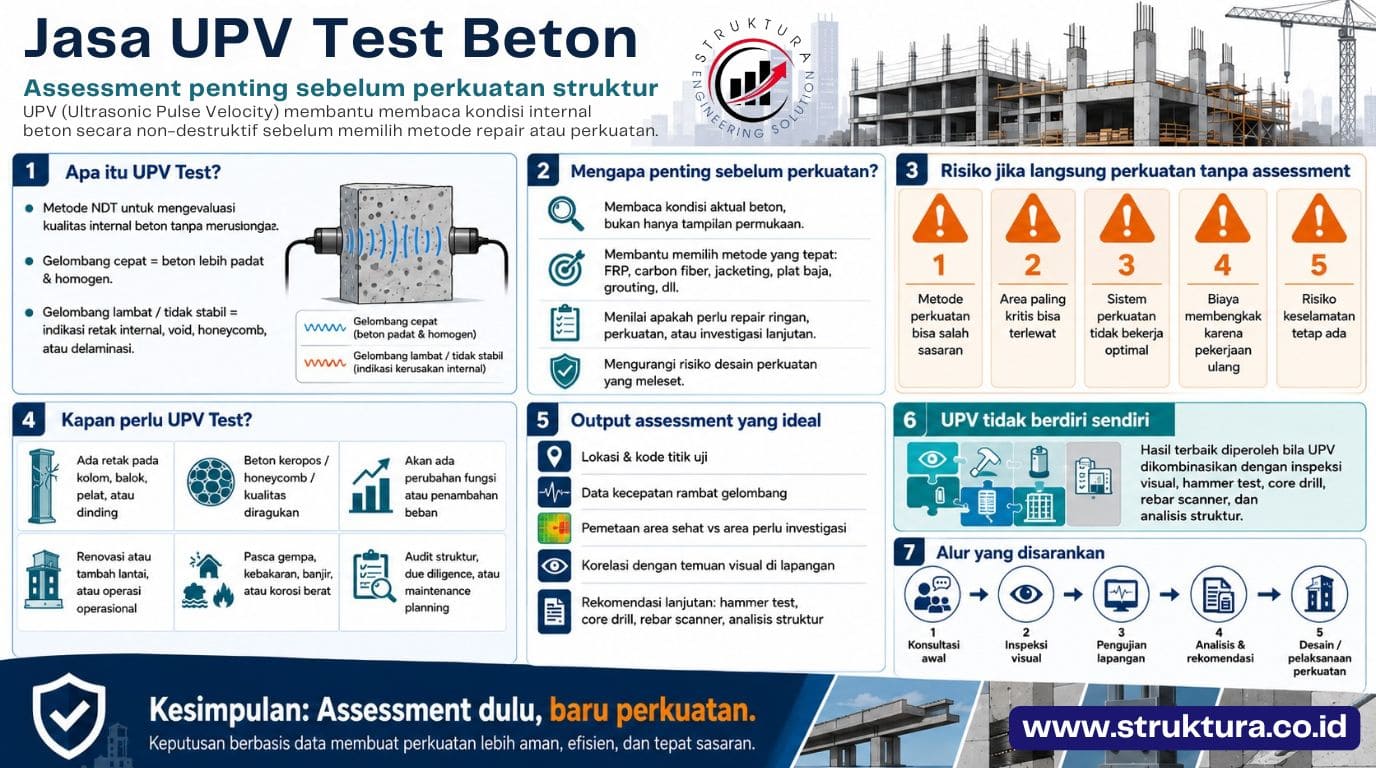
Many building owners, factory managers, warehouse operators, and industrial facility teams start looking for a structural strengthening contractor after visible warning signs appear: cracks in beams or columns, honeycombed concrete, vibrating floors, exposed reinforcement, repeated patch repair, or a plan to add new loads.
Strengthening can be the right decision. But one step should not be skipped: structural assessment.
Structural strengthening is not guesswork. Before choosing carbon fiber strengthening, FRP wrapping, jacketing, steel plate reinforcement, grouting, injection, or concrete repair, engineers need to understand the real condition of the structural element. This is where a concrete UPV test, also known as an Ultrasonic Pulse Velocity test, becomes useful as part of early investigation.
This article explains why UPV testing matters before structural strengthening, what engineers can read from the test, and why direct strengthening without assessment can lead to the wrong scope, repeated work, or unresolved risk.
If you need a test proposal, the concrete UPV testing service explains field configuration, report contents, and what to send before requesting a quotation.
What Is a Concrete UPV Test?
A UPV test is a non-destructive testing (NDT) method for concrete that uses ultrasonic waves to evaluate the internal quality of concrete without cutting or removing the structural element.
During the test, equipment sends an ultrasonic pulse through the concrete. The travel time is measured, and the pulse velocity is interpreted together with the site condition. In simple terms:
- Faster and more stable pulse velocity often indicates denser and more homogeneous concrete.
- Slower or inconsistent readings may indicate internal cracks, voids, honeycomb, delamination, or quality variation.
- Differences between test points help engineers map areas that may need further inspection.
UPV is not just a "concrete checking tool." The readings need to be interpreted by engineers who understand the structure, building history, element location, visible damage pattern, and other test methods that may be required.
Technical note: UPV testing is useful for identifying concrete uniformity and possible internal defects. For full structural capacity decisions, UPV should usually be read together with visual inspection, hammer test, rebar scanning, core drill testing where needed, and structural analysis.
Why UPV Matters Before Structural Strengthening
Strengthening only works when the actual problem is understood. In reinforced concrete buildings, damage is not always visible at the surface. A member may look acceptable from outside but contain microcracks, voids, honeycomb, or inconsistent internal concrete quality.
If those internal conditions are not identified, the strengthening design can miss the real issue. FRP installed over weak or non-homogeneous concrete may not transfer forces properly. Steel plates bonded to poor substrate may not perform as intended. Jacketing done without understanding the cause of damage may add new concrete while the original problem continues.
With a concrete UPV test, engineers gain additional data to answer practical questions:
- Is the concrete in the cracked element still dense enough?
- Is there any indication of voids or honeycomb inside a column, beam, slab, or wall?
- Is concrete quality consistent across different zones?
- Could a visible surface crack continue deeper into the member?
- Is additional testing needed, such as hammer test, core drill, or rebar scanning?
The answers help decide whether the structure needs local repair, strengthening, monitoring, or a deeper investigation before any strengthening method is selected.
Risks of Strengthening Without Assessment
From a business perspective, skipping assessment can look like a way to save time and cost. Technically, it can create the opposite result: a more expensive project, repeated work, and a repair that does not solve the root problem.
These are common risks when strengthening starts before assessment.
1. The Strengthening Method Can Target the Wrong Problem
Concrete cracks do not always mean the same thing. Cracks can come from shrinkage, overload, reinforcement corrosion, foundation settlement, machine vibration, building function changes, or poor original concrete quality.
If the cause is not understood, the chosen strengthening method may not fit the problem. Corrosion-related cracks cannot be solved only by sealing the surface. A vibrating floor caused by a load change cannot be fixed by patching the top layer. A column with voided concrete is not automatically safe just because it is wrapped with strengthening material.
Assessment helps confirm that the action addresses the cause, not only the visible symptom.
2. The Strengthened Area May Not Be the Critical Area
Structural damage is often uneven. One area may look visually severe but have a manageable structural impact. Another member may look normal but have lower concrete quality, internal voids, or reinforcement that does not match drawings.
Without testing such as UPV, hammer test, or rebar scanning, the strengthening area may be selected only from visual observation. The actual critical area can be missed, while budget is spent on a less important location.
3. The Strengthening System May Not Perform Properly
Many strengthening systems depend on concrete substrate quality. Carbon fiber, FRP, steel plate bonding, epoxy injection, and several repair systems require a sound base so force transfer can work as intended.
If the concrete beneath the surface is honeycombed, internally cracked, weak, or inconsistent, the system may experience debonding, re-cracking, or reduced performance. In that case, the failure is not always caused by the material. It may come from a method decision made without enough site data.
4. The Project Can Become More Expensive Through Rework
Strengthening without assessment can lead to late testing, method changes, partial removal of completed work, or expansion of the repair area after new problems appear.
The cost of structural assessment is usually small compared with mobilization, material, labor, production downtime, and rework. For factories and industrial facilities, even a short delay in operations can cost more than proper testing at the beginning.
5. Safety Risk Can Remain
The purpose of structural strengthening is to restore or increase capacity. If the work is carried out without knowing the actual condition, the calculated capacity may not match real site behavior.
This is especially important for public buildings, factories with heavy machinery, warehouses with high racking, buildings planned for additional floors, and structures affected by fire, earthquake, settlement, corrosion, flood, or chemical exposure.
When Should You Request Concrete UPV Testing?
Not every building needs UPV testing on a large scale. But the method is highly relevant when internal concrete quality may affect the repair or strengthening decision.
Consider UPV testing when:
- Cracks in columns, beams, slabs, walls, or other concrete members need deeper evaluation.
- Concrete appears honeycombed, porous, deteriorated, spalled, or uncertain in quality.
- The building will undergo a change of function or a significant load increase.
- A factory plans to install heavy machinery, mezzanine structures, overhead cranes, or racking systems.
- A building will be renovated, extended, strengthened, or reused for a new operational requirement.
- The structure has experienced earthquake, fire, flood, chemical exposure, settlement, or impact.
- The owner needs structural audit data for due diligence, insurance, lease decisions, maintenance planning, or internal approval.
- A structural assessment is needed before choosing repair and strengthening work.
For industrial areas such as Cikarang and Karawang, UPV testing is often combined with other NDT methods because active factories may have dynamic loads, changing production layouts, aging concrete, and limited inspection windows. For heavy industrial facilities such as Morowali, heat, vibration, corrosion, and access constraints can make early data even more important.
What Should a UPV Assessment Report Include?
A useful output is not just a table of numbers. In structural assessment, UPV data should be translated into technical guidance that owners, facility teams, consultants, and contractors can use for decision-making.
A practical report may include:
- Test locations and point codes.
- Ultrasonic pulse velocity readings at each point.
- Mapping of areas with relatively dense concrete, inconsistent readings, or indications that require further investigation.
- Site photos and test documentation.
- Correlation with visible findings such as cracks, spalling, seepage, honeycomb, or exposed reinforcement.
- Recommendation on whether hammer test, core drill, rebar scanning, or further analysis is needed.
- Initial direction on whether the condition points toward light repair, structural strengthening, monitoring, or additional investigation.
With this kind of report, the strengthening discussion no longer depends only on assumptions. The owner, consultant, facility team, and contractor have a shared technical basis for method selection, budget, schedule, and priority areas.
UPV Does Not Stand Alone
It is important to be clear: UPV testing does not replace the whole structural assessment. It is one tool for reading internal concrete condition.
On many projects, the best result comes from combining several methods:
| Investigation Need | Common Method |
|---|---|
| Concrete uniformity and possible internal defects | UPV test |
| Surface hardness and screening of concrete quality | Hammer test |
| Actual compressive strength | Core drill and laboratory testing |
| Rebar location, spacing, and cover depth | Rebar scanner |
| Crack and visible damage mapping | Visual structural inspection |
| Capacity evaluation against actual loads | Structural analysis |
This combined approach makes recommendations more reliable. If UPV readings show suspicious zones, engineers can select core drill points more efficiently. If hammer test results show concrete quality variation, UPV can help check whether the variation also relates to internal condition. If rebar scanning finds reinforcement that differs from drawings, the structural analysis can be adjusted to actual field data.
Assessment First, Strengthening Later
As a provider of structural repair and strengthening services, Struktura does not treat assessment as a delay before construction. Assessment is the basis for a more accurate, efficient, and accountable strengthening scope.
A healthier workflow is usually:
Initial consultation
The owner or facility team sends building information, damage photos, location, building function, and planned future use.Site visit and visual inspection
Engineers review crack patterns, member condition, testing access, and initial safety concerns.Field testing
UPV test, hammer test, rebar scanning, or other methods are selected based on the actual need. Not every method is required in every case.Analysis and recommendation
Field data is read together with available drawings, building history, operational requirements, and planned loads.Strengthening design and execution
If strengthening is needed, the method is selected from the data: carbon fiber, FRP, jacketing, steel plate reinforcement, grouting, injection, concrete repair, or a combination of methods.
This way, the owner receives not only construction work, but also a technical reason for why the method was selected.
Cost Factors for Concrete UPV Testing
The cost of a concrete UPV test depends on the number of test points, element type, area size, site access, project location, reporting needs, and whether testing is part of a broader structural assessment.
For a simple requirement, UPV can be performed at selected points as early screening. For a building planned for strengthening, test points should usually represent critical areas, typical members, and zones where damage or quality variation is suspected.
Because every building has different conditions, the most practical proposal is based on site needs, not a generic price. Send photos, location, structure type, and the reason for testing first so the scope can be sized properly.
FAQ About UPV Test and Structural Assessment
Does UPV testing damage concrete?
No. UPV is a non-destructive testing method, so it does not remove samples or damage the structural element. The surface only needs to be accessible so the sensors can be placed properly.
Can UPV determine concrete compressive strength?
UPV helps evaluate internal concrete quality and uniformity. For actual compressive strength, engineers usually combine it with hammer test, core drill, or laboratory testing. UPV results should not be read separately from the overall assessment context.
Is UPV needed before installing carbon fiber or FRP?
In many cases, yes, especially if concrete quality is uncertain, cracks are present, or the element needs a significant capacity increase. Carbon fiber and FRP systems need a suitable concrete substrate so load transfer can work properly.
Is UPV suitable for factory buildings?
Yes. UPV can be useful for factories with heavy machinery, vibration, layout changes, new load plans, or older buildings that have not been structurally assessed. It can be part of factory structural assessment before repair or strengthening.
How long does UPV testing take?
The duration depends on the number of test points and site access. Testing in a limited area may be completed in one working day, while a larger building or factory assessment needs a schedule aligned with site operations.
Do Not Start Strengthening From Assumptions
Good structural strengthening starts with the right questions: what is the real problem, how serious is the condition, where are the critical areas, and which method logically addresses the cause?
UPV testing helps answer part of that question by reading internal concrete condition without damaging the structure. When combined with proper structural assessment, it helps owners make decisions that are safer, more efficient, and easier to justify technically.
If your building shows cracks, honeycombed concrete, suspected quality reduction, or is being prepared for strengthening, do not choose a strengthening method only from surface appearance. Start with assessment.
Structural Assessment Consultation
Need a Concrete UPV Test Before Structural Strengthening?
Struktura's engineering team can help with UPV testing, structural inspection, and technical recommendations before you decide on repair or strengthening. Send site photos, project location, structure type, and the target strengthening scope through WhatsApp.