
Structural Strengthening for Manufacturing Plants in Karawang Industrial Estates
Karawang is one of Indonesia's largest manufacturing hubs — particularly for the automotive industry. Industrial estates such as KIIC (Karawang International Industrial City) and Surya Cipta City of Industry have served as production bases for major manufacturing corporations since the early 1990s. With buildings now reaching 25 to 30 years of age, many production facilities in Karawang are entering a phase that requires systematic structural assessment and strengthening.
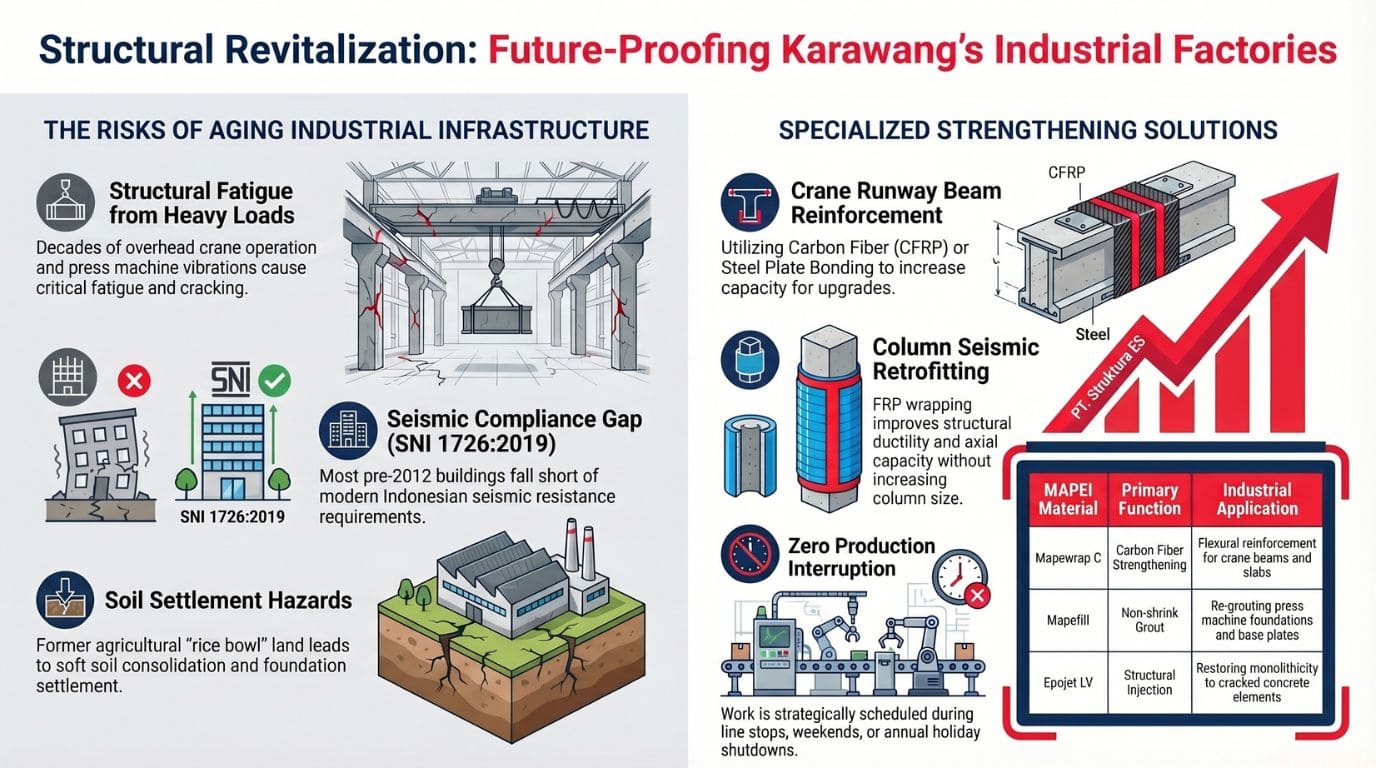
Unlike the Bekasi corridor — dominated by heavily aged buildings — or Pulogadung which requires comprehensive rehabilitation, Karawang presents more specific structural challenges: automotive factories operating heavy overhead cranes and high-tonnage press machines, ongoing production capacity expansion, and first-generation buildings approaching their structural design life. We provide structural strengthening services engineered for the specific demands of Karawang's industrial sector — using premium materials from MAPEI and an approach that prioritizes uninterrupted production continuity.
🏭 Why Do Plants in Karawang Need Structural Strengthening?
🚗
Heavy Industrial Loads
Automotive-dominant industry with heavy overhead cranes, press machines, and stamping lines that impose intensive, repeated dynamic loads on building structures
📈
Continuous Capacity Expansion
Production capacity upgrades require heavier cranes, new machinery, and mezzanine additions — all of which demand structural evaluation and strengthening before implementation
📐
Updated Seismic Code Requirements
SNI 1726:2019 significantly raises seismic design loads — buildings from the 1990s need re-evaluation for code compliance and structural safety
Karawang Industrial Estate Map and Building Age Profile
Karawang hosts several managed industrial estates that developed since the early 1990s — making them slightly newer than Cikarang — but first-generation buildings are now approaching their structural design life.
📍 Karawang Industrial Estates — Estimated Building Age:
KIIC (Karawang International Industrial City)
Operational since the early 1990s. Developed as a joint venture with the involvement of Itochu Corporation (Japan). First-generation buildings are now 30+ years old. Well known as the production base for major automotive manufacturers including Toyota Motor Manufacturing Indonesia (TMMIN) and Daihatsu. High concentration of Japanese-owned manufacturing companies.
Surya Cipta City of Industry
Developed by PT Suryacipta Swadaya (a subsidiary of PT Surya Semesta Internusa Tbk) since the early 1990s. Spanning over 1,400 hectares. First-generation buildings are 25–30 years old. Mixed tenant base across manufacturing and logistics sectors.
Indotaisei Industrial Estate
Industrial estate with strong Japanese investor backing. Mixed-age building stock from the 1990s through the 2010s. High concentration of Japanese companies in the automotive and component manufacturing sectors.
Other Industrial Zones and New Developments
Includes Karawang New Industry City (KNIC) and other newer developments. Buildings generally under 15 years old. Still relevant for structural evaluation when load changes, capacity expansion, or compliance with the latest standards is required.
📌 Key context: Karawang is recognized as Indonesia's automotive manufacturing center. Plants in KIIC and Surya Cipta house full vehicle production lines with heavy-duty equipment — large-capacity overhead cranes, multi-thousand-ton press machines, welding lines, and paint shops. These operational loads are extremely intensive and directly shape the specific structural strengthening requirements of each facility.
Specific Structural Challenges in Karawang Industrial Estates
Karawang has a distinct structural challenge profile — driven by the dominance of automotive and heavy manufacturing, former agricultural land conditions, and the constant pressure of ongoing production capacity expansion.
1. Extremely Heavy Operational Loads from Automotive Manufacturing
The automotive industry generates the heaviest structural loads of any manufacturing sector — a combination of large-capacity overhead cranes, high-tonnage press machines, and intensive vibration from stamping and welding operations.
⚙️ Typical Operational Loads in an Automotive Factory:
Large-Capacity Overhead Cranes
Automotive plants use overhead cranes with capacities of 10–50 tons or more to move dies, vehicle bodies, and heavy components. Crane runway beams receive massive repeated dynamic loads every time the crane operates.
Press and Stamping Machines
Body panel press lines carry tonnages of hundreds to thousands of tons. Every press stroke transmits impact loads and vibration directly to the machine foundation and surrounding structure — with thousands of cycles per day.
Welding and Assembly Lines
Automotive welding lines use large-capacity robots and jigs supported by the building structure. Vibration and dynamic loads from the spot welding process accumulate year after year.
Paint Shop and Curing Ovens
Paint shop and curing oven areas generate high temperatures that cause thermal stress in surrounding concrete structural elements. Repeated thermal cycling over many years accelerates structural degradation.
Cumulative impact after 25–30 years of operation:
- Crane runway beams experience fatigue from millions of dynamic load cycles
- Press machine foundations develop cracks and settlement from continuous vibration
- Crane support columns accumulate decades of imposed loads
- Structural elements in the paint shop zone degrade due to repeated thermal cycling
2. Significantly Updated Seismic Code Requirements
As with the entire West Java region, Indonesia's seismic design standards have changed substantially since the buildings in Karawang were originally designed.
📜 Evolution of Seismic Code Standards for the Karawang Region:
SNI 1726:2002
Legacy standard — used when most factories in KIIC and Surya Cipta were originally designed
SNI 1726:2012
First revision — seismic hazard maps updated based on new seismological data
SNI 1726:2019
Currently enforced — design seismic loads for the Karawang region are significantly higher than the standard used during original construction
Buildings designed before 2012 are highly likely to fall short of the seismic resistance requirements under the currently enforced SNI 1726:2019. For automotive plants housing heavy cranes and extremely high-value production assets, structural damage from a seismic event is not only a safety risk — it represents a catastrophic asset loss risk.
3. Former Agricultural Land Conditions
Karawang has historically been known as West Java's rice bowl. Many industrial estates in Karawang were built on land previously used for paddy fields and agriculture.
Structural implications of these soil conditions:
- Soft alluvial soil — former rice paddy land is typically soft with lower bearing capacity than undisturbed natural ground
- High groundwater table — former rice field areas have irrigation systems and relatively high groundwater tables, causing permanent moisture exposure on foundations
- Settlement risk — soft agricultural land is more susceptible to settlement, particularly differential settlement that causes damage to superstructure elements
- Long-term consolidation — in some cases, fill material in industrial areas continues to consolidate for years after construction, causing ongoing settlement
💡 Note: Foundation settlement in Karawang factories can directly affect crane runway alignment — which is operationally critical for overhead cranes in automotive plants. Even a deviation of a few millimeters in the crane rail can disrupt operations and accelerate wear.
4. Capacity Expansion and Equipment Upgrades
Karawang remains a highly active growth corridor. Many factories continue to scale up production capacity — which means increasing loads on existing structures.
📈 Expansion Scenarios That Require Structural Evaluation:
Crane Upgrade to Higher Capacity
Replacing a 10-ton crane with a 20-ton or larger unit to support new, heavier vehicle model production. Crane runway beams and support columns must be evaluated and potentially strengthened.
Installation of New Production Lines
Adding new press machines, welding robots, or conveyor systems that require evaluation and strengthening of foundations and supporting structures.
Mezzanine Floor Addition
Building mezzanine floors for storage, offices, or sub-assembly areas. Existing columns and foundations must be evaluated for the additional loads.
Rooftop Equipment Additions
Solar panels, new HVAC ducting, AHUs, or scrubbers installed on the roof — adding loads to roof framing and ring beams that were not accounted for in the original design.
5. Strict Safety Standards from Multinational Automotive Principals
Multinational automotive corporations — particularly from Japan — enforce global safety standards that often exceed local regulatory requirements. This creates additional demand for structural assessment and strengthening.
Implications for automotive plants in Karawang:
- Periodic audits from headquarters — parent companies in Japan, South Korea, or Europe regularly audit facility conditions, including structural safety aspects
- Internal seismic resistance standards that may be more stringent than local SNI requirements
- Full documentation requirements for structural condition and load capacity
- Compliance obligations that must be met to maintain approved manufacturing facility status
- Production asset protection — automotive tooling (dies, robots, press machines) carries extremely high replacement value, meaning structural damage translates to massive financial loss
Most Critical Strengthening Needs in Karawang
Based on the dominance of automotive manufacturing, building age profile, and expansion dynamics in Karawang industrial estates, the following structural needs are most urgent.
1. Crane Runway Beam Strengthening — The Top Priority for Automotive Plants
Crane runway beams are the most critical structural elements in Karawang's automotive factories. After 25–30 years of dynamic loading from large-capacity cranes, many crane runway beams show signs of fatigue damage — or must be upgraded to support higher-capacity cranes.
Typical conditions observed in 25–30-year-old automotive plants:
- Flexural cracking at mid-span from millions of crane load cycles
- Diagonal shear cracks near supports — an area of critical stress concentration
- Permanent deflection that increases over time
- Reinforcement corrosion in areas exposed to moisture or roof leaks
- Wear and damage on bearing pads at supports
Common upgrade scenarios:
- Existing 10-ton crane to be replaced with a 20-ton or larger unit
- New crane installation in a bay that previously had no crane
- Increased crane operating frequency due to higher production targets
Solutions we provide:
- Existing crane beam capacity evaluation — structural analysis of whether the beam can sustain the new crane loads
- Flexural strengthening with Carbon Fiber (MAPEI MapeWrap C UNI-AX 300/600) — increases flexural capacity without adding dead load to the structure
- Steel Plate Bonding with MAPEI Adesilex PG1 — adds stiffness and capacity, highly effective in reducing crane beam deflection
- Shear strengthening with U-wrap FRP — reinforces critical zones near supports
- Crack injection (MAPEI Epojet LV) — restores concrete monolithicity before strengthening is applied
- Bearing pad evaluation and replacement — ensures crane supports function optimally
💡 For automotive plants: Crane runway beam strengthening can be scheduled during planned line stops, weekends, or model changeover periods — windows when the crane is not in full operation. We coordinate directly with your production team to minimize operational impact. See details on our Carbon Fiber Strengthening and Steel Plate Bonding pages.
2. Column Strengthening for Seismic Retrofit and Load Increases
Factory columns in Karawang face a dual challenge: seismic retrofit to meet updated code requirements, and capacity upgrades to accommodate production expansion.
Typical column conditions in 1990s-era Karawang factories:
- Column stirrup spacing that does not meet SNI 1726:2019 confinement requirements
- Axial capacity approaching its limit due to incremental load additions (mezzanines, heavier cranes, rooftop equipment)
- Early-stage corrosion on columns in wet or humid process areas
- Localized damage from forklift collisions in warehouse and loading dock areas
Solutions we provide:
- FRP Confinement (MAPEI MapeWrap G UNI-AX 900) — improves confinement, axial capacity, and seismic ductility without significantly increasing column dimensions
- Carbon Fiber Wrapping (MAPEI MapeWrap C UNI-AX) — for high-strength shear and confinement requirements
- Concrete Jacketing — for severely damaged columns or where large capacity increases are needed
- Concrete repair (MAPEI Mapefer 1K + Mapegrout Thixotropic) — localized repair for columns affected by corrosion or impact damage
💡 For HQ audit compliance: Seismic retrofit work can form part of the structural compliance documentation required by your parent company. Proactive evaluation helps you arrive at the audit ready — not reactive. See details on our FRP Strengthening and Column Jacketing pages.
3. Machine Foundation Repair and Strengthening
Automotive plants in Karawang house press and stamping machines with extremely high tonnages, whose foundations have absorbed intensive vibration over decades. Former agricultural land conditions add further settlement risk.
Common machine foundation problems:
- Foundation cracking from 25–30 years of vibration accumulation
- Machine foundation settlement — particularly on former paddy soil still undergoing consolidation
- Deteriorated or debonded grout between machine base plates and concrete foundations
- Machine misalignment caused by uneven settlement
- Foundations inadequate for new, heavier machinery or machines with different vibration profiles
Solutions we provide:
- Crack injection (MAPEI Epojet) — restores concrete monolithicity in cracked machine foundations
- Re-grouting (MAPEI Mapefill or Mapegrout Hi-Flow) — replaces deteriorated grout with premium non-shrink grout
- Foundation strengthening — where existing foundation capacity is insufficient for replacement machinery
- Structural evaluation and recommendations — analysis of whether existing foundations are compatible with proposed replacement equipment
4. Production Floor Slab Strengthening and Repair
Factory floors in Karawang automotive plants bear loads from multiple sources — forklifts transporting components, AGVs (automated guided vehicles), pallets, and internal vehicle traffic.
Common floor slab problems:
- Cracking from decades of repeated forklift traffic
- Localized settlement or depression — particularly on former agricultural soils
- Deteriorated construction joints
- Capacity upgrade requirements for new equipment layouts or heavier floor loads
- Surface wear along primary traffic lanes
Solutions we provide:
- Slab strengthening with Carbon Fiber (MAPEI MapeWrap C UNI-AX 300) — increases flexural capacity
- Crack injection (MAPEI Epojet / Epojet LV) — restores slab monolithicity
- Void grouting (MAPEI Mapefill) — fills voids beneath settled slabs
- Surface and joint repair (MAPEI Mapegrout Hi-Flow / Fast Set) — repairs worn surfaces and deteriorated construction joints
5. Structural Strengthening for Expansion and Capacity Upgrades
Plants in Karawang that are continuously scaling up production frequently require modifications to existing building structures.
📈 Strengthening to Support Capacity Expansion:
Mezzanine Floor Addition
Adding mezzanine floors for sub-assembly areas, component storage, or production offices. Existing columns and foundations must be evaluated for additional loads.
Crane Capacity Upgrade
Increasing crane capacity to support new vehicle model production. Crane runway beams, support columns, and foundations must be evaluated before the upgrade proceeds.
Production Machinery Replacement
New machines that are heavier or have different vibration characteristics require machine foundation and surrounding structure evaluation.
New Production Line in Existing Building
Installing new production lines within an existing building requires evaluation of whether the structure can accommodate additional loads and new vibration profiles.
Solutions we provide:
- Existing capacity evaluation — comprehensive structural analysis of whether the structure can support new loads
- FRP Confinement on columns — increases axial capacity for additional loads
- Beam strengthening with Carbon Fiber or Steel Plate Bonding at new load points
- Foundation evaluation and strengthening where indicated by structural analysis
💡 Important: A structural evaluation before expansion can prevent major cost overruns. Knowing your existing structural capacity upfront enables better planning — whether strengthening is needed, to what extent, and how to align the schedule with production operations.
6. Structural Repair in Aggressive Environment Zones
Automotive factories contain several areas where the operating environment accelerates concrete structural degradation.
Areas with specific environmental challenges:
- Paint shop — high temperatures from ovens and curing areas cause thermal stress in concrete
- Electroplating / surface treatment — exposure to aggressive chemicals accelerates reinforcement corrosion
- Wet process areas — high humidity accelerates carbonation and corrosion
- Wash bays — repeated water and detergent exposure on lower structural elements
Solutions we provide:
- Concrete repair (MAPEI Mapefer 1K + Mapegrout Thixotropic) — repair of elements affected by corrosion and spalling
- FRP Wrapping (MAPEI MapeWrap) — structural strengthening combined with a barrier against chemical penetration and moisture
- Protective coating (MAPEI Elastocolor) — long-term protection for structural elements in aggressive exposure environments
Strengthening Methods We Provide
Each method is selected based on structural analysis results and calibrated to the specific needs of Karawang factories — with particular attention to crane dynamic loads and the requirement for minimal production downtime.
🧵 Carbon Fiber Strengthening (CFRP)
Material: MAPEI MapeWrap C UNI-AX 300/600
Applications in Karawang: Crane runway beams, production floor slabs, ring beams, flexural strengthening
- Fast application — 2–3 days per element
- No dead load addition to the structure
- Exceptionally high strength-to-weight ratio
- Ideal for crane beam strengthening without halting production
🔷 Glass Fiber Strengthening (GFRP)
Material: MAPEI MapeWrap G UNI-AX 900
Applications in Karawang: Column confinement, seismic retrofit, shear strengthening
- More cost-effective — ideal for multi-column retrofit programs
- Excellent confinement effect for columns
- Improves seismic ductility as required by SNI 1726:2019
- Well-suited for crane support column retrofit
🔩 Steel Plate Bonding
Material: Steel plate + MAPEI Adesilex PG1
Applications in Karawang: Crane runway beams, primary beams, strengthening for dynamic loads
- Adds significant stiffness — highly effective in reducing crane beam deflection
- Familiar approach for automotive plant maintenance teams
- Proven for repeated dynamic loading from cranes
- Cost-competitive material option
🧱 Concrete Column Jacketing
Material: Reinforced concrete + shear connectors
Applications in Karawang: Severely damaged columns, crane support columns, large capacity upgrades
- Maximum capacity increase among all methods
- Most cost-efficient per unit of capacity added
- Ideal for columns required to support significantly heavier new cranes
- Repairs damage while simultaneously strengthening
Concrete Repair and Patch Materials
For concrete damage such as spalling, reinforcement corrosion, cracking, and deterioration from aggressive environments, we use products from MAPEI:
| MAPEI Product | Function | Application in Karawang Plants |
|---|---|---|
| Mapefer 1K | Anti-corrosion reinforcement coating | Protection of exposed rebar on columns, beams, paint shop and wet process areas |
| Mapegrout Thixotropic | Overhead/vertical repair mortar | Spalling repair on columns, crane beams, forklift impact damage |
| Mapegrout Hi-Flow | Flowable repair mortar | Production floor repair, machine foundation grouting |
| Mapegrout Fast Set | Rapid-set repair mortar | Fast repair in critical areas — sets in 30 minutes |
| Epojet / Epojet LV | Structural crack injection | Crack injection in crane beams, columns, machine foundations, floor slabs |
| Mapefill | Non-shrink cementitious grout | Re-grouting crane base plates, press machine foundations, anchor bolts |
| Elastocolor | Protective coating | Long-term protection for structural elements in paint shop and wet process areas |
| MapeWrap 12 | FRP protective coating | UV and environmental protection for FRP strengthening systems |
💡 Materials only? If your plant maintenance team wants to carry out minor repairs in-house, we supply MAPEI products for direct purchase. Material selection consultation is free. Visit our MAPEI Applicator and Distributor page.
Our Approach for Projects in Karawang Industrial Estates
Automotive plants operate on extremely tight production schedules with very low tolerance for downtime. Our approach is designed to work within these operational constraints — including leveraging specific windows in the automotive production cycle.
🔄 Our Project Workflow:
- 1
Initial Consultation and Site Visit
Discussion of your structural concerns, expansion plans, or upgrade requirements. On-site visit for a preliminary assessment. Free and non-binding for factories in Karawang industrial estates and surrounding areas.
- 2
Structural Investigation and Testing
Visual damage mapping, concrete quality testing (hammer test, UPV, core drill), rebar scanning, crane beam deflection measurement, machine foundation condition assessment. Carried out with minimal disruption to production operations.
- 3
Structural Analysis and Strengthening Design
Evaluation of existing capacity versus demand — including new crane loads, seismic loads per SNI 1726:2019, and expansion loads. Selection of the optimal strengthening method based on analysis, not assumptions.
- 4
Proposal and Production Schedule Coordination
Detailed proposal with scope, method, timeline, and cost. Work schedule is coordinated around your production cycle — line stops, model changeovers, weekends, annual shutdowns, or Lebaran holiday periods.
- 5
Execution
Carried out by a team operating to industrial safety standards — factory safety induction, full PPE, permit to work compliance, JSA, and LOTO (Lock Out Tag Out) procedures for work in proximity to cranes and moving equipment. Premium MAPEI materials with strict quality control throughout.
- 6
Quality Control and Documentation
Post-work inspection, before-and-after photographic documentation, complete technical report — formatted for HQ audit submission if required.
Why Choose Us for Your Karawang Plant
🚗 Deep Understanding of Automotive Industry Requirements
We understand the specific load profile of automotive plants — heavy cranes, press vibration, paint shop thermal stress. Our structural analysis accounts for actual dynamic loads, not just static approximations.
📐 Analysis-Driven, Not Assumption-Based
Every recommendation is grounded in structural investigation and analysis. For crane upgrades or capacity expansion, we accurately evaluate existing structural capacity before designing any strengthening solution.
⏱️ Aligned with Automotive Production Cycles
Work is coordinated with your production schedule — line stops, model changeovers, annual shutdowns. We recognize that every minute of downtime on an automotive line represents significant financial loss.
🧪 MAPEI-Certified Premium Materials
MAPEI products are certified for structural applications in heavy industrial environments — vibration-resistant, chemically resistant, and engineered for long service life in demanding conditions.
📋 Technical Reports Formatted for HQ Audits
Our technical documentation can be tailored to the format required by your parent company's audit process — including full investigation data, structural analysis, and before-and-after records.
📍 Direct Access to Karawang
Based in Bekasi with direct access to the Karawang corridor via the Jakarta–Cikampek Toll Road. Fast response for consultations, site visits, and project mobilization.
Industrial Estates We Serve in Karawang and Surrounding Areas
🏭 KIIC
Karawang International Industrial City — Indonesia's premier automotive manufacturing hub with major tenants including Toyota and Daihatsu
🏭 Surya Cipta
Surya Cipta City of Industry — large-scale industrial estate spanning over 1,400 hectares with a diverse multi-sector tenant base
🏭 Indotaisei
Indotaisei Industrial Estate — estate with a high concentration of Japanese companies in automotive and component manufacturing
🏭 KNIC
Karawang New Industry City — newer industrial estate development in the Karawang corridor
🏭 West Karawang Corridor
Industrial areas around Telukjambe and Klari — a mix of standalone factories and managed industrial estates
🏭 Surrounding Areas
Other factories and manufacturing facilities throughout Karawang Regency and along the border with Cikarang
📍 Our location: Based in Bekasi with direct access to all Karawang industrial estates via the Jakarta–Cikampek Toll Road. We also serve industrial estates in Cikarang, Bekasi, and other areas. See our Factory Structural Strengthening page for services in other industrial corridors.
Types of Projects We Handle in Karawang
The following are examples of structural strengthening work relevant to factories and manufacturing facilities in Karawang industrial estates:
- Crane runway beam strengthening — for fatigue damage or crane capacity upgrades
- Structural assessment for crane upgrades — analysis of whether existing structures can sustain heavier new cranes
- Seismic retrofit — column evaluation and strengthening to comply with SNI 1726:2019
- Crane support column strengthening — increasing axial and shear capacity for higher crane loads
- Machine foundation repair and strengthening — re-grouting, crack injection, and foundation strengthening for press and stamping machines
- Mezzanine addition structural strengthening — column and foundation evaluation and strengthening for added floor loads
- Production floor slab strengthening — crack repair, void grouting, capacity upgrades
- Structural strengthening for new production line installation — evaluation and strengthening for new machinery and equipment loads
- Structural repair in paint shop areas — repair of elements degraded by thermal stress
- Corrosion repair in wet process areas — repair and strengthening of elements in electroplating and surface treatment zones
- Ring beam repair and strengthening — repair and strengthening affected by roof water ingress
- Crane base plate re-grouting — replacement of deteriorated grout at crane supports
FAQ — Factory Structural Strengthening in Karawang
Our plant is upgrading its crane from 10 tons to 20 tons. Can the existing structure handle it?
Not necessarily — and a structural evaluation is essential before the upgrade proceeds. Increasing crane capacity from 10 tons to 20 tons means:
- Loads on the crane runway beams increase significantly — not simply doubled, because dynamic and impact factors also change
- Crane support columns carry greater vertical and lateral loads
- Crane column foundations must sustain increased loads
- Rails and bearing pads may need upgrading or replacement
What we do:
- Capacity evaluation of crane runway beams, support columns, and foundations against new crane loads
- Gap analysis — quantifying exactly how much additional capacity needs to be provided
- Strengthening design — the most effective and efficient solution for your specific case
- Strengthening execution — scheduled to align with your production cycle
This evaluation is best carried out early in the crane upgrade planning phase — not after the new crane has already been ordered.
Our press machine foundation is cracked. Can it be repaired without removing the machine?
Yes, in many cases it can. Machine foundation repair can be carried out without permanently relocating the machine — though the machine may need to be temporarily deactivated during the repair:
- Foundation cracks can be injected with MAPEI Epojet to restore monolithicity
- Deteriorated grout beneath the machine base plate can be replaced by re-grouting with MAPEI Mapefill (non-shrink grout)
- Minor settlement can be compensated through re-grouting and shimming
For more severe cases (significant settlement or major structural damage), the machine may need to be temporarily lifted for more comprehensive foundation repair. An evaluation is needed to determine the appropriate approach.
Work can be scheduled during planned line stops or model changeovers to minimize impact on production.
Our plant at KIIC is due for an audit by our Japanese principal. Can you help us prepare?
Yes. Japanese automotive corporations typically enforce global building safety and facility management standards that every plant must meet. We can assist with:
- Structural evaluation against the currently enforced seismic standard SNI 1726:2019
- Critical element condition assessment — crane beams, columns, machine foundations — with measured testing data
- Gap analysis between existing conditions and applicable standards
- Technical report in a professional format suitable as compliance documentation for the audit
- Strengthening recommendations and execution for any elements found to be non-compliant
Proactive evaluation before the audit arrives is far preferable to responding to audit findings under a tight deadline. Our reports can be adapted to the format requested by your headquarters.
Does the plant need to halt production during strengthening work?
Not necessarily. We understand that production downtime at an automotive plant is extremely costly. Most work can be scheduled to minimize operational impact:
- Crane runway beam strengthening: Scheduled when the crane is not in operation — line stops, weekends, or model changeover periods
- FRP/Carbon Fiber strengthening: Minimal disruption — can be carried out while production continues in adjacent areas
- Column strengthening: Can be done column by column in rotation without shutting down the entire area
- Machine foundation repair: Scheduled when the machine is not in operation
For automotive plants, we specifically leverage the following production windows:
- Scheduled line stops (typically several days per month)
- Model changeovers (during transitions between production models)
- Annual shutdown (year-end or Lebaran holiday period)
- Golden Week (for plants following the Japanese production calendar)
- Weekends (Saturday–Sunday)
How long does the work take?
It varies depending on scope. The following are reference estimates:
- Strengthening 1 crane beam with CFRP: 2–3 days
- Strengthening 1 crane beam with steel plate: 3–5 days
- Strengthening 1 column with FRP wrapping: 1–2 days
- Jacketing 1 column: 2–3 weeks (including curing time)
- Re-grouting 1 machine foundation: 2–3 days per machine
- Crack injection of 1 machine foundation: 1–2 days per foundation
- Multi-element seismic retrofit program: Phased in accordance with structural priority ranking and production schedule
For large-scale projects, work is carried out zone by zone or bay by bay to avoid disrupting the entire production area simultaneously.
What about HSE (Health, Safety, and Environment) standards at automotive plants?
Our team understands and adheres to the HSE standards applicable in automotive factory environments — which are generally more stringent than general industry requirements:
- Compliance with your plant's safety induction requirements
- Full PPE appropriate to each work area
- Permit to work compliance (hot work permits, confined space entry, working at height)
- LOTO (Lock Out Tag Out) for all work in proximity to cranes and moving equipment
- JSA (Job Safety Analysis) for each scope of work
- Toolbox meetings before commencing work each day
- MSDS documentation available for all products used
- 5S compliance in the work area — maintaining cleanliness and order to Japanese factory standards
Is there a free structural assessment for plants in Karawang?
Yes. We provide a free preliminary assessment for factories in Karawang industrial estates and surrounding areas. This initial assessment covers:
- On-site visit and visual observation of structural conditions
- Identification of potential issues on critical elements — crane beams, columns, machine foundations, floor slabs
- Discussion of expansion plans, equipment upgrades, or current structural concerns
- Initial recommendations and next steps
There is no obligation to proceed further. Our aim is to give you an honest initial picture of your building's structural condition.
Are MAPEI materials available for direct purchase?
Yes, they are. In addition to structural strengthening services, we also distribute MAPEI products. If your plant maintenance team wants to carry out minor repairs in-house, you can purchase materials such as:
- Mapegrout (repair mortar for concrete repairs)
- Mapefer 1K (anti-corrosion rebar coating)
- Epojet / Epojet LV (structural crack injection)
- Mapefill (non-shrink grout — widely used for base plate and machine foundation re-grouting)
- Elastocolor (protective coating for paint shop and wet process areas)
- And other MAPEI products
Material selection consultation is free. Full details on our MAPEI Applicator and Distributor page.
What is the estimated cost for structural strengthening at a Karawang factory?
Costs vary depending on several factors:
- Type of work (crane beam strengthening, column retrofit, foundation repair, or a combination)
- Method selected (CFRP, steel plate bonding, FRP, jacketing)
- Number of elements requiring treatment
- Existing condition and extent of damage
- Work schedule (standard hours vs. line stop / weekend / shutdown windows)
Contact us for a free site visit and we will prepare a detailed proposal based on the actual conditions and specific requirements of your facility.
📞 Free Consultation and Site Visit for Karawang Plants
Is your plant planning a crane upgrade? Is your building over 20 years old? Are you adding a new production line, mezzanine floor, or new machinery? Are you preparing for an audit from your parent company?
We provide a free, no-obligation preliminary structural assessment for factories in Karawang industrial estates — KIIC, Surya Cipta, Indotaisei, and surrounding areas.
A structural evaluation before expansion or upgrade work begins can prevent major costs and avoid problems down the line. Contact us to schedule a site visit and discuss your plant's structural requirements.