
Locate the Areas That Need Corrosion Verification
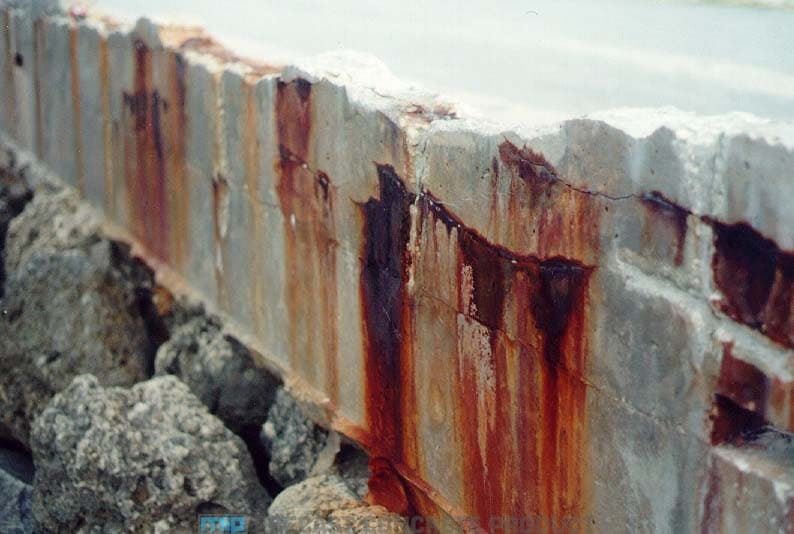
Rust staining, longitudinal cracks, and spalling reveal where deterioration is visible. They do not show how far the indication extends into adjacent concrete. A Half-Cell Potential survey helps an owner, maintenance team, or engineer compare corrosion-potential patterns across defined zones and decide where to verify, sample, monitor, or plan repair next.
Struktura offers Half-Cell testing as a standalone mapped survey when that is the question, or as one component of a broader structural assessment. The proposal defines the grid, access to reinforcement, surface conditions, map, interpretation, and limits before testing begins. The map supports prioritization; it is not a measurement of corrosion rate, steel loss, structural capacity, or remaining service life.
What to share before requesting a survey
Send the structure type and location, elements and approximate area, photos of rust, cracking, spalling or leakage, information on paint or waterproofing, drawings or reinforcement details if available, access rules, and the map or report format your team needs.
When the Map Changes the Next Step
- Visible rust or spalling: compare the damaged area with adjacent surfaces before choosing verification openings or a repair boundary.
- Coastal, wet, chemical, or older structures: investigate the distribution of potential readings in parking structures, basements, factories, bridges, and marine facilities where durability questions matter.
- Concrete repair or protection planning: use mapped zones to direct cover checks, carbonation or chloride testing, local openings, and other confirmation work.
- Maintenance baseline: repeat measurements at consistent grid points and record the conditions needed to interpret changes over time.
- Asset due diligence or CAPEX: show which zones warrant closer investigation before a budget or intervention is finalized.
The method measures electrical potential between electrically connected reinforcing steel and a reference electrode at the concrete surface. A grid of readings reveals relative patterns and gradients that can indicate different probabilities of corrosion activity under suitable conditions. ASTM C876-22b addresses corrosion-potential estimation for uncoated reinforcing steel in concrete; it does not turn these readings into structural properties of the steel or element.
Check Survey Feasibility Before Promising a Map
| Site condition | Why it matters | Scope decision |
|---|---|---|
| Reinforcement continuity | Electrically separate bars or zones may not be comparable as one map. | Confirm a suitable connection and continuity before the main grid. |
| Paint, membranes, or waterproofing | Insulating layers can prevent adequate electrical contact. | Review the finish and agree on any local opening and reinstatement. |
| Epoxy-coated reinforcement | The cited ASTM method is not applied to epoxy-coated bars. | Check drawings or verify the reinforcement condition first. |
| Moisture and temperature | They affect contact, concrete resistivity, and readings. | Record conditions and apply a consistent field procedure. |
| Cover depth, geometry, and access | Thick cover can smooth local variation; working height limits practical grid density. | Agree on accessible zones, grid resolution, and any access equipment. |
Surface readings are generally nondestructive, but an electrical connection to the reinforcement may require a local opening. That opening, permission, and reinstatement should be included in the agreed scope. Electrode type, contact, reinforcement configuration, cover, exposure, moisture, and temperature belong in the interpretation. One potential value should never be used as a universal pass or fail threshold for a structure.
From Site Grid to a Usable Report
We first clarify what the map must inform and review the structure, exposure, symptoms, repair history, drawings, finishes, and reachable areas. The survey area is divided into traceable zones; grid spacing follows the element size, variation, access, and resolution needed. The team establishes the reinforcement connection and continuity, records the electrode and surface conditions, then gathers stable readings at identified points. Unexpected readings are checked before leaving the area.
| Agreed deliverable | What the team receives | Decision it supports |
|---|---|---|
| Area plan and grid | Elements, zones, point IDs, and connection location. | Trace each value to the field. |
| Point readings and conditions | Potential values, reference electrode, date, and relevant surface or environmental conditions. | Review the basis of the map and compare future surveys appropriately. |
| Contour map | Distribution and gradients within the area actually tested. | Identify zones for verification, monitoring, or repair investigation. |
| Interpretation and limits | Patterns, field factors, uncertainty, and recommended next checks. | Decide what information is still needed before intervention. |
A contour map is not a drawing of remaining bar diameter or final concrete-repair quantity. The guide to reading Half-Cell results (Indonesian) provides further detail on point data and map legends.
Choose the Method for the Question
| Question | Method to consider |
|---|---|
| Where do potential patterns suggest different likelihoods of corrosion activity? | Half-Cell Potential Test. |
| Where are the bars and how much concrete cover is indicated? | Rebar Scanning. |
| How far has carbonation progressed from the surface? | Carbonation testing. |
| What is the chloride profile by depth? | Sampling and laboratory analysis scoped for that question. |
| What is the strength of a concrete sample? | Concrete coring (Indonesian) and laboratory testing. |
| What repair or load decision should the owner make? | Structural assessment integrating the necessary condition, material, reinforcement, load, and analysis data. |
Half-Cell can be ordered independently when the area and question are limited to potential mapping. If the owner needs the damage cause, remaining reinforcement section, repair quantity, protection strategy, structural capacity, or CAPEX priorities, the investigation may also require visual inspection, delamination checks, Rebar Scanning, carbonation or chloride tests, concrete resistivity, local opening, coring, or structural analysis. These are selected for the decision, not bundled automatically.
What Drives Price and Schedule?
Area alone is not enough for a defensible quotation. The number and geometry of elements, grid resolution, continuity checks, coating or membrane, access height, permits, HSE requirements, local opening and reinstatement, travel, and deliverable format all affect work. A denser grid is useful when the decision needs that resolution; otherwise it can add cost without changing the next action.
To request a proposal, send the project location, building or infrastructure function, zone sizes, normal and damaged-area photos, finish type, reinforcement drawings if available, access and operating hours, the intended reader of the report, whether raw readings and a contour map are required, and the target date. The reply can then distinguish a standalone survey from a wider corrosion assessment.
Half-Cell Potential Test FAQ
Is the test entirely nondestructive?
Readings at the surface do not remove concrete, but the electrical connection to reinforcement may need a local opening and reinstatement under the agreed scope.
Does it measure corrosion rate?
No. It maps potential and supports interpretation of the likelihood of corrosion activity. Rate needs other data and methods.
Does the contour map show remaining bar diameter?
No. Section loss needs separate verification, potentially including a planned local opening and direct measurement.
Can readings be taken through paint or waterproofing?
An insulating layer may prevent adequate contact. The finish must be reviewed, and local opening may be needed with the owner's agreement.
Is it suitable for epoxy-coated reinforcement?
The cited ASTM C876 method does not apply to epoxy-coated bars. Reinforcement details should be checked before that survey is promised.
What grid spacing is required?
There is no single spacing for every structure. Element size, desired resolution, condition variation, access, and the decision determine the grid.
Does one survey establish that a structure is safe?
No. Potential readings do not establish capacity or safety. That decision requires a broader assessment with appropriate condition, load, and engineering data.
Will the report include a map and interpretation?
Yes, when agreed in the proposal. The deliverable can include point and grid plans, raw readings, a contour map, field conditions, technical interpretation, limitations, and recommended verification.
Map the Area Before Fixing a Repair Scope
Send the affected zones, photos, finish, reinforcement information, access conditions, and the decision the report must support. We can review whether a standalone map answers it or more investigation is needed.
Discuss a Half-Cell Survey