
Structural Assessment for Factories in Indonesia
Factory structural assessment helps owners, plant managers, and procurement teams make safer decisions before machinery upgrades, racking changes, crane work, repair, or strengthening projects.
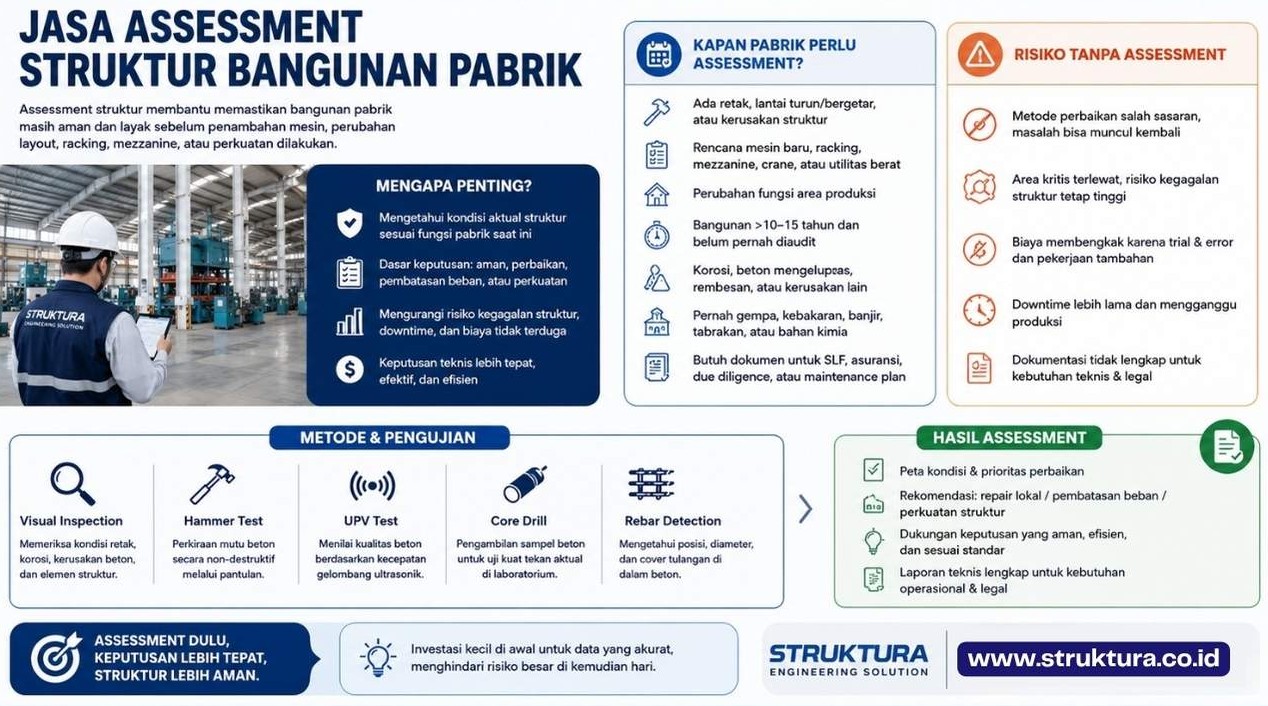
Factories rarely stay the same as their original design. Production lines move, machines become heavier, warehouse areas become denser, forklift traffic increases, overhead cranes are upgraded, rooftop utilities are added, and mezzanine or platform structures appear over time.
From an operations perspective, these changes are normal. From a structural engineering perspective, every change can alter the loads carried by columns, beams, slabs, roof framing, foundations, crane beams, machine pedestals, and connections.
This is why structural assessment for factories in Indonesia should be treated as a decision tool, not a formality. A proper assessment helps answer whether the existing structure is still adequate, whether loads should be limited, whether local repair is enough, or whether structural strengthening is required before the factory continues with its planned upgrade.
Factory owners, plant managers, facility managers, EHS teams, engineering managers, consultants, and procurement teams use structural assessment to create a practical basis before approving repair, strengthening, machinery installation, racking upgrades, crane work, or due diligence on an existing industrial building.
Why Factory Structural Assessment Matters
Factory buildings are different from ordinary commercial buildings. They often carry a combination of static, dynamic, and operational loads that change over time.
Common factory conditions include:
- Machine vibration and repeated dynamic loading.
- Forklift and reach-truck traffic on production or warehouse slabs.
- Overhead crane loads on runway beams and supporting columns.
- Racking loads that concentrate force at base plates.
- Pipe racks, platforms, tanks, conveyors, ducts, cable trays, and rooftop utilities.
- Heat, moisture, chemical exposure, corrosion, leakage, or aggressive process environments.
- Production constraints that make full shutdown difficult.
The risk is that many factory buildings are no longer used exactly as intended in the original design. A light production area may become material storage. A slab designed for pedestrian and light cart traffic may now carry forklifts. Columns may support new platforms, pipe supports, or crane loads. Roof structures may carry solar panels, ducts, exhaust units, or new service platforms.
Without structural assessment, repair and strengthening decisions can become expensive guesses.
When Should a Factory Request Structural Assessment?
Structural assessment does not need to wait until a serious defect appears. In active factories, the most valuable assessment is often the one performed before damage turns into downtime.
Consider assessment when a factory has any of the following conditions:
- Cracks in columns, beams, slabs, crane beams, walls, machine foundations, or roof-support elements.
- Spalling concrete, exposed reinforcement, corrosion stains, honeycomb, leakage, or repeated patch repair failure.
- Floor vibration, slab settlement, uneven floors, or cracks along forklift paths.
- New machinery, heavier production equipment, tanks, conveyors, pipe racks, or utility supports.
- New or higher racking systems, denser pallet storage, or heavier forklift traffic.
- Crane capacity upgrade, new hoist, altered crane operation, or runway beam concerns.
- Mezzanine, platform, rooftop equipment, solar panels, HVAC, exhaust, or additional service loads.
- Missing drawings, uncertain as-built conditions, or undocumented past renovations.
- Fire, flood, earthquake, impact damage, chemical exposure, or long-term corrosion risk.
- Due diligence before leasing, buying, expanding, reactivating, or insuring an industrial building.
- Internal audit, headquarters review, insurance requirement, lender review, or compliance documentation.
For factories in active industrial corridors such as Cikarang and Karawang, assessment is often linked to production expansion, machinery upgrades, and warehouse load changes. For heavier industrial sites such as Morowali, heat, vibration, corrosion, and limited shutdown windows may make early assessment even more important.
Risks of Repair or Strengthening Without Assessment
When a factory already has cracks, spalling, or vibration complaints, it is understandable that the owner wants a quick repair. The problem is that quick repair without assessment can target the symptom while missing the cause.
The Repair Method Can Be Wrong
A slab crack may come from shrinkage, forklift loading, settlement, low concrete quality, racking base-plate loads, or vibration. Each cause requires a different response. Injection, patching, overlay, FRP, CFRP, jacketing, or steel plate reinforcement should not be selected only from a photo.
If the cause is not understood, the same defect may return after repair.
The Critical Area Can Be Missed
The most visible damage is not always the most critical structural risk. A column may look acceptable but have low concrete quality. A beam may show minor cracks but carry a new concentrated load. A slab may look flat but have voids or insufficient thickness below racking points.
Assessment helps prioritize the actual risk instead of only treating the area that looks worst.
Strengthening May Not Perform as Intended
Methods such as carbon fiber strengthening, FRP strengthening, column jacketing, steel plate reinforcement, injection, grouting, and concrete repair all depend on the existing condition.
Substrate quality, reinforcement layout, cracking pattern, corrosion risk, load path, access, and operational constraints affect whether the method is suitable. For FRP specifically, see the guide on choosing an FRP strengthening contractor.
Downtime Can Become Longer
Assessment helps define sequence: which area needs immediate attention, which test can be done during operation, where access must be restricted, whether temporary shoring is needed, and which repair can be planned during a shutdown window.
Without this planning, the project may become reactive: more tests are added late, methods are changed on site, completed repair is removed, or production areas stay closed longer than expected.
What a Factory Structural Assessment Should Cover
The assessment scope should match the factory condition and the decision that needs to be made. A light screening for early budgeting is different from a detailed assessment before major strengthening or load increase.
In general, factory structural assessment can include the following.
1. Document and Operational Review
Engineers review available structural drawings, as-built information, architectural drawings, renovation history, equipment data, crane capacity, racking layout, machine foundation details, and planned use changes.
If drawings are missing or unreliable, field verification becomes more important. The assessment may need to reconstruct the existing condition through measurement, element mapping, photos, and selective testing.
2. Visual Structural Inspection
Visual inspection maps cracks, spalling, corrosion, leakage, deflection, settlement, impact damage, honeycomb, exposed reinforcement, joint damage, and other visible defects.
For factories, the inspection should connect visible symptoms to operations: forklift routes, machine locations, crane usage, racking zones, wet process areas, chemical exposure, drainage, roof leakage, and maintenance history.
3. Load and Use Mapping
Factory assessment is not only about concrete quality. The existing and planned loads must be understood.
Important load information may include:
- Machine weight, vibration, and baseplate conditions.
- Forklift type, wheel load, traffic route, and frequency.
- Racking height, pallet weight, base-plate layout, and future storage density.
- Crane capacity, operating frequency, runway beam condition, and column support.
- Mezzanine, conveyor, pipe rack, tank, or platform loads.
- Rooftop additions such as ducts, solar panels, exhaust units, or HVAC equipment.
This step helps engineers compare actual factory use against what the structure is likely carrying.
4. Concrete Testing and NDT When Needed
Not every assessment requires every test. Engineers select methods based on risk, available access, decision stage, and the consequence of uncertainty.
| Need | Common Method | Role in Assessment |
|---|---|---|
| Visual damage mapping | Structural inspection | Identifies crack patterns, spalling, corrosion, deflection, and areas needing further checks |
| Concrete quality screening | Hammer test | Gives an early indication of surface hardness and relative concrete quality |
| Internal concrete quality | UPV test | Helps screen possible voids, honeycomb, cracks, or non-uniform concrete |
| Actual compressive strength | Core drill and laboratory testing | Confirms concrete strength where higher certainty is required |
| Reinforcement location and cover | Rebar scanning | Helps identify reinforcement layout and avoid rebar during coring |
| Corrosion risk | Carbonation, chloride, half-cell, or related checks | Supports decisions in wet, coastal, chemical, or older environments |
| Capacity against current loads | Structural analysis | Connects field data with actual factory loads and planned use |
Testing should not be treated as a checklist. It should answer a decision: whether the area is safe to use, needs load limitation, requires repair, or needs strengthening.
5. Analysis and Recommendation
The final assessment should translate site findings into decisions. A useful report does not stop at photos and test numbers.
Factory owners and procurement teams typically need:
- Which areas are acceptable for continued operation.
- Which areas need load limitation or restricted access.
- Which defects need immediate repair.
- Which elements need strengthening.
- Whether the planned machinery, racking, crane, platform, or rooftop load is acceptable.
- Which strengthening methods are suitable or unsuitable.
- What additional data is needed before final design or execution.
- How the work can be phased around production and safety constraints.
This is the point where assessment becomes commercially useful. It gives management a basis for CAPEX, procurement, repair planning, insurance discussion, or contractor comparison.
Example Factory Scenarios
Every factory is different, but the assessment logic often follows patterns like these:
| Factory Situation | Assessment Focus | Possible Recommendation Direction |
|---|---|---|
| Forklift path slab cracks | Slab thickness, concrete quality, joint condition, wheel loads | Crack repair, joint repair, slab strengthening, local thickening, or load management |
| New racking system | Slab capacity, base-plate load, settlement risk | Racking layout adjustment, slab verification, local strengthening, or foundation review |
| Heavier production machine | Machine foundation, vibration, slab, nearby columns | Foundation strengthening, re-grouting, anchor repair, vibration review, or pedestal redesign |
| Crane capacity upgrade | Runway beam, columns, connections, deflection | Beam strengthening, column strengthening, connection repair, or load limitation |
| Column damaged by forklift impact | Column geometry, reinforcement, cracking, loss of section | Local repair, FRP wrapping, jacketing, or protective bollards after repair |
| Factory without drawings | Element dimensions, reinforcement, concrete quality, current loads | Existing-condition mapping and capacity analysis before repair or strengthening |
| Rooftop utilities or solar panels | Roof framing, connections, bracing, ring beam, columns | Load verification, layout adjustment, steel strengthening, or concrete member checks |
The assessment should help the owner decide what to do first, what can wait, and what should not be ignored.
Assessment Before Choosing a Contractor or Method
Some projects start by asking for a contractor price. That can be useful when the scope is already defined. But for factory structures, the first useful step is often a technical scope discussion.
If your team is comparing contractors, use assessment to clarify:
- Is this a local repair or structural strengthening project?
- Which method is technically suitable?
- What assumptions are being used for pricing?
- What areas still need testing?
- What should be excluded from early estimates?
- What work can happen during operation, and what needs shutdown?
The article on choosing a structural strengthening contractor in Indonesia explains this contractor-selection side in more detail.
What to Send Before Requesting a Factory Structural Assessment
To get a useful response, prepare a concise project brief. It does not need to be perfect, but it should help the engineering team understand the risk.
Send the following if available:
- Factory location and industrial area.
- Factory function: manufacturing, warehouse, cold storage, logistics, heavy industry, chemical process, food and beverage, automotive, or other use.
- Photos: wide photos, close-up damage photos, and access-condition photos.
- Affected areas: slab, column, beam, roof structure, crane beam, machine foundation, racking area, wall, or mezzanine.
- Symptoms: cracks, spalling, corrosion, leakage, vibration, deflection, settlement, repeated repair failure, or impact damage.
- Planned change: machine installation, racking upgrade, crane upgrade, mezzanine, solar panels, rooftop equipment, process-line relocation, or change of function.
- Available documents: drawings, equipment data, layout plan, previous test result, repair record, or internal audit note.
- Operational constraints: production hours, shutdown window, safety rules, access permit, height restriction, crane availability, and target schedule.
- Decision stage: early budget, CAPEX approval, procurement comparison, due diligence, urgent risk review, or execution planning.
This information helps separate a preliminary review from a proper site assessment, and prevents misleading proposals based only on assumptions.
How Struktura Supports Factory Structural Assessment in Indonesia
Struktura Engineering supports owners, consultants, facility managers, plant engineering teams, and procurement teams that need assessment-led decisions for industrial buildings.
For the service scope, testing choices, report contents, and proposal inputs, see Struktura's structural assessment and building audit service.
Our support may include:
- Initial consultation based on photos, location, symptoms, and project objective.
- Site visit and visual structural inspection.
- Structural condition mapping for slabs, columns, beams, roof structures, crane beams, machine foundations, or other critical areas.
- Concrete testing coordination where needed, including hammer test, UPV, core drill, rebar scanning, or other relevant checks.
- Load review for machinery, racking, crane, mezzanine, rooftop equipment, or production changes.
- Assessment report with repair, strengthening, monitoring, or load-limitation recommendations.
- Follow-up execution through structural repair and strengthening services, factory structural strengthening, machine foundation repair, carbon fiber, FRP, jacketing, or other suitable methods.
The most valuable assessment is the one done before the wrong repair method is purchased, before production is interrupted unexpectedly, and before a small defect becomes a shutdown problem.
Need structural assessment for a factory in Indonesia?
Send the factory location, photos, affected area, symptoms, planned load or use change, available drawings, access constraints, and target schedule. Struktura can help define whether the next step should be site assessment, concrete testing, repair planning, or strengthening scope discussion.
Discuss Assessment ScopeFAQ
Can factory structural assessment be done without stopping production?
Often yes. Many visual inspections, measurements, selected NDT tests, and document reviews can be planned around operating hours. Some areas may need temporary access restriction, especially if the element is critical, difficult to reach, or located near active machinery.
Do all factories need core drill testing?
No. Core drill testing is used when actual compressive strength data is needed or when other test results require confirmation. For early screening, visual inspection, hammer test, UPV, and rebar scanning may be enough, depending on the decision being made.
When should assessment be done before installing new machinery?
Ideally before the machine layout and foundation details are finalized. This allows slab capacity, machine foundation needs, vibration concerns, anchor details, and surrounding structural members to be reviewed before procurement and installation begin.
Is structural assessment the same as strengthening work?
No. Assessment is the diagnosis and recommendation stage. Strengthening is the follow-up action if the assessment shows that capacity is insufficient or structural repair is required. In factory projects, both stages should be connected so the strengthening method is based on actual site data.
Can assessment support procurement or CAPEX approval?
Yes. A clear assessment report can help management, procurement, consultants, insurers, or asset owners understand the issue, risk level, recommended scope, assumptions, and next steps before approving budget.
What if the factory drawings are missing?
Assessment can still begin with field measurement, visual mapping, photos, element dimensions, selected testing, and load information from operations. Missing drawings increase uncertainty, but they do not prevent the first assessment step.